



What did winter do to your rims?
After winter, have you taken a close look at your rims—not just from a distance, but really up close? If so, you'll recognize the scene: a grey-brown film of brake dust, topped with a layer of salt residue, and interspersed with fine, rust-brown spots. That's industrial fallout—tiny iron particles from brake discs and railway tracks that eat into the clear coat of the rim. What becomes visible in a week or two in summer has built up undisturbed over an entire winter. And that's exactly the problem: the longer this mixture of brake dust, road salt, and industrial fallout sits on the rim surface, the deeper it eats in.
Road salt is the worst culprit. As long as it lies frozen on the rim, little happens. But as soon as temperatures rise above 4°C—and that's exactly what's happening now in spring—the salt crust becomes an active electrolyte solution. This means it accelerates corrosion. On painted aluminum rims, this attacks the clear coat; on unpainted rims, it directly affects the aluminum. Therefore, spring cleaning is not only important for the paint—your rims need attention just as urgently.

Acid-free, alkaline, or acidic—which wheel cleaner for what?
The selection of wheel cleaners is vast, and as a beginner, you quickly face the question: What should I use? The answer depends on how severe the contamination is and what type of rim you have. Basically, there are three categories, and each has its justification.
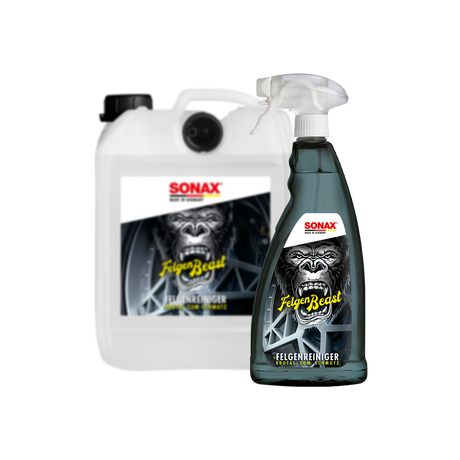
Acid-free wheel cleaners with color change are the best starting point for most car owners. They work with so-called thioglycolic acid—despite the name, not a classic acid, but an active ingredient that specifically dissolves iron particles. The trick: You see where the cleaner is working. It turns purple-red in areas where brake dust and industrial fallout are present. The SONAX FelgenBeast is my workhorse here—it tackles stubborn brake dust and shows you exactly when you need to follow up with its color change. For the private user, the FelgenBeast is a safe bet because it works on all common rim types: painted, polished, chromed aluminum rims, and steel rims.
If you prefer something a bit more compact and targeted, you should check out the Koch-Chemie ReactiveWheelCleaner. Also pH-neutral with a color change, but from Koch-Chemie's professional line—very economical and extremely straightforward to use. Both products are equally safe for coated and uncoated rims.
Alkaline wheel cleaners like the Koch-Chemie Alkali Wheel Cleaner primarily dissolve greasy dirt and oil residues. They are ideal if tar or road grime is sticking to the rim in addition to brake dust. The disadvantage: no color change, so you have to estimate yourself when it has acted long enough. For the winter dirt mix of salt, grease, and brake dust, however, an alkaline cleaner is sometimes a more effective choice than a purely acid-free one.
And then there's the D-CON V4 Wheelcleaner & De-Ironizer—a hybrid that combines wheel cleaning and de-ironizing in one step. For anyone looking for a particularly efficient workflow after winter, this is an exciting option. It also works with a color change and is rim-safe.


Cleaning Rims — Step by Step
Before you start, an important principle: always work on a cold rim. After driving, brake discs and rims are hot—if you spray a wheel cleaner on them now, it will evaporate immediately and can leave stains. So: let them cool down for at least 30 minutes, ideally in the shade.
Start with a thorough rinse using a high-pressure cleaner or garden hose. This removes loose dirt, grit, and coarse grime. Then spray your chosen wheel cleaner evenly over the entire rim—don't forget the back of the spokes and the rim bed. This is precisely where most of the dirt accumulates during winter.
Allow the cleaner to sit for 3–5 minutes. For products with a color change, you will now see the cleaner change color. During this time, you can use a wheel and engine brush to clean the spaces between the spokes and hard-to-reach areas. A good brush makes all the difference here—because the most stubborn brake dust is in the corners that no sponge can reach.

Then rinse thoroughly with plenty of water. From top to bottom, so that the loosened dirt drains away instead of settling again. For heavy contamination—which is usually the case after an entire winter—repeat the process a second time. The first pass removes the top layer of dirt; the second tackles the baked-on residues underneath.
The most common mistakes when cleaning rims
By far the most common mistake I see: spraying wheel cleaner on hot rims. This has been said before, but it cannot be stressed enough. The second biggest mistake: too short an exposure time. If you start scrubbing after 30 seconds, you're wasting half of the cleaning power. Give the product time to work—that's what it's formulated for.
Mistake number three is reaching for household cleaners. Dish soap, brake cleaner, or even vinegar have no place on rims. Dish soap degreases aggressively and attacks sealants. Brake cleaner is a solvent that can damage rubber seals and tire sidewalls. And vinegar—an acid—can attack the clear coat of the rim if left on for too long. Real wheel cleaners are specifically formulated for this: they dissolve brake dust and industrial fallout without damaging the rim surface.
And something else many people don't know: brake dust isn't just dirt—it's chemically aggressive. The fine iron particles from the brake pads react with moisture and oxygen. The result is industrial fallout, which settles in the micropores of the clear coat. The longer it sits there, the harder it becomes to remove. That's why cleaning rims after winter isn't an option, but a must—just like the spring wash for the paint.
Daniel's Tip: After cleaning, a wheel sealant is worthwhile. A good sealant like the D-CON Wheel & Rim Wax V2 ensures that brake dust can be removed much more easily—for the next wash, a rinse with a high-pressure cleaner is often enough. Similar principle to a spray sealant for paint—protect once, significantly less effort afterwards.

Conclusion: Clean rims are not a luxury—they are protection
Cleaning your rims after winter is one of the most important steps in spring car care. Road salt, brake dust, and industrial fallout have sat undisturbed on your rims for months—now, as temperatures rise, they begin to actively corrode. A good wheel cleaner, a decent brush, and 15 minutes per wheel—that's all it takes to prevent this. And if you apply a sealant afterwards, you'll have significantly less work for the rest of the year.
Check out our wheel cleaners in the shop—whether acid-free with color change or alkaline for extreme cases, you'll find the right product for every rim. If you have any questions, just chat with us.
No time for the whole post? Get it summarized:
Add Detailing1 as a preferred source on Google