



Decontaminating paint: Why washing alone isn't enough after winter
You've washed your car, it's shining, the winter grime is gone — and yet the paint feels rough when you run your hand over it. It’s not your imagination. What you’re feeling are contaminants: fallout, industrial dust, tar residue, and brake dust that have become embedded in the clear coat over the months. A normal wash won't remove this. For that, you need decontamination — the step most people skip, only to wonder why their sealant doesn't last.
Especially now in April, after a long winter of road salt, splash water, and cold nights, it is the perfect time for thorough paint preparation. If you already took the first step in the spring wash post, it’s time to go deeper: Decontamination means removing everything that water and shampoo can't handle.

What is actually sitting on your paint — and why won't it come off?
The term "decontamination" sounds technical, but it describes something very specific: removing particles that have chemically or mechanically bonded with the paint surface. Fallout (rail dust) is the best-known example — tiny iron particles from brake dust and rail traffic that settle into the clear coat and oxidize there. On white or light-colored vehicles, you see this as orange spots; on dark paint, you only notice it when running your hand over it.
Add to that tar and bitumen splatter from the road, especially after roadworks in the fall, which have dried over the winter. Industrial dust, which settles as a fine film and reacts chemically when moisture is present. And brake dust, which doesn't just attack the rims — some of it also ends up on the paint, especially around the wheel arches and rocker panels. All these contaminants are stuck fast. Shampoo won't loosen them because they aren't loose dirt, but have embedded themselves into the pores of the clear coat.

The three pillars of decontamination: Chemical, mechanical, solvent-based
Effective decontamination works in three stages, and the sequence is crucial. Anyone starting with the clay bar before the fallout has been chemically dissolved is dragging iron particles across the paint — and that causes scratches, not cleanliness.
Stage 1: Chemical decontamination — dissolving fallout. A thioglycolic acid-based fallout remover reacts with the embedded iron particles and lifts them out of the clear coat without mechanically stressing the surface. Spray the product onto the clean, wet paint and wait 3–5 minutes. The characteristic color change to violet shows you where iron is being dissolved — the darker the discoloration, the more contamination was present. Then rinse thoroughly with water. For this, I reach for the D-CON "Light" Pre-Cleaner & De-Ironizer — it’s formulated as a fallout remover, but is mild enough for regular use even on sealed surfaces. If you want to do your wheels at the same time, you can use the D-CON "V4" Wheelcleaner & De-Ironizer — more highly concentrated, ideal for burnt-on brake dust on rims, but for paint, the "Light" version is gentler.

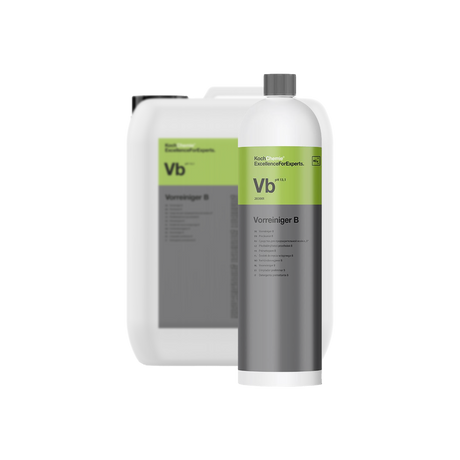
Stage 2: Solvent-based — removing tar and adhesives. What the fallout remover doesn't catch are organic contaminants: tar, bitumen, insect remains, adhesive residues. These need a solvent. The Koch-Chemie Teerwäsche A "Tea" is a classic here — a solvent-based cleaner that you apply specifically to the affected areas, let it work briefly, and then wipe off. Smells like a workshop, but it works reliably. Do not use over large areas; use it specifically where you see tar splatter or black dots. Afterward, re-wash the spot with shampoo to remove any solvent residue.
Stage 3: Mechanical decontamination — claying. Now comes the step where you really feel what’s happening. A clay bar glides over the paint with clay lubricant and picks up everything that wasn't chemically dissolved: stubborn industrial particles, paint overspray, mineral deposits. The blue Koch-Chemie Cleaning Clay "Rkb" Mild is the right choice for most cases — fine enough not to unnecessarily abrade the clear coat, but abrasive enough to reliably grab contaminants. If your car hasn't been clayed in years or has been heavily exposed to industrial pollution, reach for the red "Rkr" version — significantly more aggressive, so only use it if it's really necessary.

When claying, the lubricant is not optional. Without it, you drag the loosened particles across the paint and create exactly the scratches you want to avoid. The Koch-Chemie Clay Spray "Cls" is made for this — spray a generous amount onto a 30×30 cm area, clay with light pressure in straight lines, and fold the clay after each area so the picked-up particles disappear inside. You will feel the difference immediately: rough before, glass-smooth after.
If you find standard clay bars difficult to use or want to treat larger areas more efficiently, you can use a Koch-Chemie Clay Scrubber or the Clay Pad instead — both work on the same principle, but with a flat surface that works faster on large areas like hoods and roofs than a clay block. The downside: they are slightly less precise in corners and edges.
Typical mistakes — and why the order is everything
The most common mistake I see: people clay first. Without prior chemical decontamination, the clay pushes iron particles across the paint. That is the fastest way to get new swirl marks. Chemically dissolve first, then mechanically remove — this order is non-negotiable.
Second mistake: Too much pressure when claying. The clay works through adhesion, not friction. Light pressure, plenty of lubricant, straight lines. If you press as if you’re massaging the paint, you’ll cause more damage than cleaning. And third: Not applying a sealant after decontamination. You have just stripped everything off the surface — including the last layer of protection. Now the paint is exposed, naked, sensitive. A sealant or at least a spray sealant should be applied within 24 hours. The SONAX XTREME Ceramic Spray Sealant is an uncomplicated finish here — spray on, spread, wipe off. No coating effort, but immediate protection and good durability for the coming weeks.

Daniel's tip: Perform the "plastic bag test" before and after decontamination. Put your hand inside a thin plastic bag (a freezer bag works fine) and run it over the wet paint. The bag significantly enhances your sense of touch — you will feel every roughness, every fallout point. You will feel it clearly before, and afterward, the bag will glide as if on ice. That is the moment you know: the paint is now truly clean.
Conclusion: Decontamination is the step that makes the difference
A thorough wash is the foundation — but it is only the foundation. If you really want to care for your paint, you have to go deeper: chemically dissolve fallout, target tar, mechanically smooth the surface, and seal it afterward. This process takes perhaps an hour longer than a normal wash, but you will feel and see the result immediately. Smoother paint, better water beading, longer sealant durability — and the knowledge that your paint is truly clean, not just looking clean.
Everything you need for complete decontamination can be found at our shop under Paint Preparation. And if you want to know how to protect your paint from pollen, which really picks up in April — check out our post on that.
No time for the whole post? Get it summarized:
Add Detailing1 as a preferred source on Google