



In this kind of rain you can tell straight away whether your windscreen is still sealed
A deep low is pushing across north-west Germany today, and here in Nordhorn we're sitting at barely 8 degrees with rain forecast all day long. Sounds like a bad day for your car glass sealant at first. It's actually one of the best diagnosis days of the year. You don't need to buy anything or lay anything down for it. If you've got a glass sealant on your car, you can check whether it's still holding without a single tool. Just glance out the window and watch the drops on your windscreen.
You spot an intact glass sealant on your car by the cleanly rounded beads of water that climb up the glass on their own from around 50 km/h, without the wipers having to lift a finger. A dead layer shows itself as a broad, flat film of water and as that squeak the moment the wiper drags across a dry patch. Which of the two you're looking at decides whether you only need a cleaner today or a full re-seal.
Beads or a film. May rain tells you the truth
If your windscreen beads, the sealant is doing its job. The water pulls up into domed, ball-shaped drops that hold a contact angle of 100 to 110 degrees. The drops roll at the slightest tilt and tear off the glass by themselves from around 50 to 55 km/h, with no wiper input at all. The sealant is still working.
If your windscreen doesn't bead but forms a flat, closed film of water, the layer is gone. That's not a cosmetic detail, it's a safety factor. At night and against oncoming light the film scatters the headlights of oncoming cars diffusely across the whole screen and measurably cuts how well you can pick out pedestrians and cyclists. The second you switch the wipers on, you hear the second diagnosis test: an intact sealant lets the rubber glide. A dead one produces that telltale squeak, because the wiper blade is scraping over microroughness in the glass instead of floating on a hydrophobic film.
Most sealants last between 6 and 12 months on the windscreen. The premium layers hit the full 12 months the maker quotes under ideal conditions, while the quick-apply sprays sit closer to 4 to 6 months. On side windows, which see less wiper mechanics and less UV, an SiO₂ layer often survives three to four times as long.
The diagnosis takes three seconds. Stand off to the side of the glass, look into the light and watch how the water reacts on the surface. Tall, clearly separated drops are a yes. A merging, milky haze is a no. If you've got a phone within reach, snap the state quickly — next year's May rain lets you make the comparison exactly, and you'll know how your sealant has aged.
Glass isn't smooth. That's exactly why sealing works
A car glass sealant means a chemically bonded hydrophobic layer that lets water bead off instead of soaking in. Float glass looks mirror-smooth to the eye, but under the microscope it has a microroughness where dirt and insect remains dig in. A sealant fills those pits with a thin polymer layer of silicon and oxygen and smooths the surface on a molecular level. For you that means bird droppings, pollen and diesel residue get no grip any more and come off with the next rain.
Most pro glass sealants work with polysiloxane networks or with fluoropolymers. Polysiloxane coatings like the GYEON Q² View build a cross-linked silicon-oxygen framework on the glass that cures over 12 to 24 hours after you lay it down and then feels like a fresh glass finish. Fluoropolymer sprays like the Soft99 Glaco family build a short-chain, highly hydrophobic layer that kicks in faster and wears off faster too. That's not a quality gap, it's a different build for a different use case.
Both types need the same thing: absolutely clean, grease-free glass. If a thin silicone film or a surfactant residue is sitting under the sealant, the polymer can't bond. It works for a week, then flakes off, and you're left wondering why the 12-month lifespan doesn't add up. The maker didn't lie. The pre-wash simply wasn't thorough enough.

Don't wash today. Today you check, plan and buy
You don't lay a glass sealant down in the rain. You need dry glass, a surface temperature between 10 and 25 degrees and a day where no spray hits the fresh layer head-on. Today is diagnosis day. As soon as the weather clears and the glass is dry, the workflow runs in four steps.
Step one is a deep clean with a concentrated glass cleaner that has no wax or silicone additives. The Koch-Chemie Glas Star Gla diluted 1:10 as a concentrate, or the ready-to-use Glass Cleaner Gc for home use, pulls pollen, diesel film and wax residue out of the microstructure. Two passes are standard, one wiping horizontally and one vertically, so streaks show up before you seal over them. You wipe it off with a waffle glass cloth or the SONAX ProfiLine glass cloth. These cloths have a tight waffle weave that pulls smears away instead of spreading them around.
Step two is the sealing itself. Dampen the applicator pad, work in straight, slightly overlapping lanes, not in circles. Step three is the 5 to 15 minute wait while the layer keys in. Step four is buffing off with a second, dry waffle cloth until the glass is completely clear. Full curing then runs 12 to 24 hours, and no water can touch the glass in that phase.
Do the prep properly and you save yourself corrections later. Streaks in the sealant can't be reworked; they have to come off again with a fine glass polish and then the whole thing gets re-sealed. One hour spent on the application saves you half a Saturday of rework. If the pre-wash steps from the streak-free wiping post are second nature, you've already cracked the hard part. Sealing builds on the same wiping craft, just with a different product.
Three sealing routes in the Detailing1 range
Under the umbrella of car glass sealant we carry three sensible routes that map different effort-to-lifespan curves. The first route is the GYEON Q² View EVO Rain Repellent as a premium polysiloxane. The layer lasts up to 12 months on the windscreen according to the maker, and up to 36 months on less-stressed side windows. You apply it with an applicator pad, then 24 hours of cure time. That's the right pick if you want to do a clean job once a year and rack up a lot of motorway miles.
The second route is the GYEON Q² QuickView, a spray version of the same polymer family. Lifespan around 4 to 6 months, application in five minutes. QuickView is the pick for city drivers who can top it up more often, or as a stopgap between two View EVO seasons. The third option on a comparable level is the INNOVACAR SC3 Glass Sealant, also SiO₂-based and with a similar core lifespan, but a slightly shorter curing phase.
The third route is the light option via a 2-in-1 solution. The GYEON Q²M Glass+ cleans and seals in the same pass and leaves a thin, short-lived hydrophobic layer for about 6 to 8 weeks. Handy: you don't have to run a separate pre-wash. Realistically: the layer is thinner and won't survive a high-pressure foam cycle at the car wash. If you reach for the Meguiars Ultimate Glass Cleaner, you get the same logic on a slightly different surfactant base, with the option of letting the sealing ride along during a routine clean. An overview of every glass product in the range sits in the Glass Cleaners category and under Windscreen Sealants — split by cleaning step and sealing step.
For most private customers, route two is the most honest way in. You put in an hour, learn the application on a manageable area, and after one season you see whether the effect was worth the effort to you. Anyone who then wants to move up to route one already has the craft down and knocks out the premium job in a single garage session. Stick with the light route and you'll run through summer and autumn with a clear view, without much prep or rework. Which route suits you depends less on your wallet than on the time you're willing to put in regularly.

Four mistakes that kill any sealant early
The most common mistake is applying to glass that's too cold or too warm. Below 10 degrees the polymer won't cure through; above 25 degrees the carrier solvent flashes off too fast and you get streaks you can't polish out again. The garage option at 18 to 22 degrees with no direct sun is the most honest sealing weather there is. May hands you these windows between the rain, you just have to grab the right one.
The second mistake is a pre-wash with an all-purpose cleaner that leaves surfactant residue behind. A standard interior cleaner or a supermarket glass cleaner drags silicone components into the surface that stop any polymer from bonding. If you clean with the Koch-Chemie Mzr before sealing, you have to follow up with a pure glass cleaner afterwards so the base is surfactant-free.
The third mistake is neglecting the wipers. A sealant lives and dies by the blade running over it. A worn blade with a hard rubber edge sands the polymer layer off in a matter of weeks. Before every re-seal, the wipers should get a clean with a microfibre cloth and a bit of glass cleaner. If the rubber is cracked, just swap it out — the May season change is the right moment for it anyway.
The fourth mistake is the car wash in the first 24 hours. A fresh sealant can't take high pressure, hot wax or the alkaline pre-wash from the tunnel sprayers. Not until it's fully cured. Until then the rule is: hand routine, no petrol-station car wash, no jet-wash-bay lance pre-rinse. Those 24 hours are the difference between 12 months of lifespan and 12 weeks.
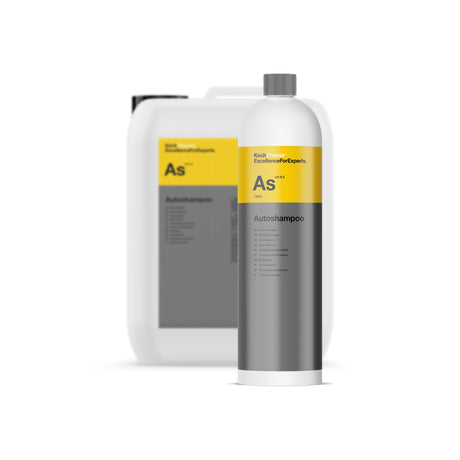
A fifth, quieter mistake only shows up after weeks: the wrong routine wash with a cheap, strongly alkaline shampoo. Wash weekly with a pH-12 pre-cleaner and you break the polysiloxane layer down from the top — the same thing that happens with paint coatings. On a sealed windscreen, pH-neutral shampoo isn't just comfort, it's protecting your investment. If you want to dig into the pH question, the background is in the all-purpose cleaner guide, where we run the scale across the whole care chain.
What you do after sealing so next May's rain looks different
A fresh car glass sealant needs patience in the first two weeks and very little after that. Patience means: no wiper dragged dry across the glass, no ice scraper on the glass polymer layer, no hot water. Cleaning in this phase happens only with clear water, a damp glass cloth and, in an emergency, a mild, pH-neutral glass cleaner with no wax added.
After that the care becomes routine. Every 4 to 8 weeks a thorough wipe with clear water and a waffle cloth, once a month a quick visual check: still beading? Wiper squeaking dry? If so, nothing's broken — that's the early sign the layer is being used up. A quick-apply layer like the QuickView lets you make up for the wear between seasons without running the full premium application every time.
The most honest lifespan answer comes from how your car gets driven: do 60 kilometres of country roads a day and you'll hold a Q² View EVO layer for nearly the whole year. Stick to city driving in 50-zones and the hydrophobic mechanism rarely gets up to its tear-off threshold, so you'll reach for the wiper more often. That's not a weakness of the sealant, it's the physics of speed. The layer still lasts longer than nothing — you just won't see it until the next 100-km/h stretch.

Detailing1 insight: If you really want to push the sealant to 12 months, drive a short stretch without the wipers two or three times in the first week in dry weather after applying. In this phase the airflow alone does more for the cross-linking of the polymer layer than any polishing step. We see it routinely on deliveries: three days of city driving without the wipers and the beading runs like day one. Seal in May and get it right, and you'll look at the next autumn rain with different eyes.
No time for the whole post? Get it summarized: