Car fogging up on the inside: why a clean windscreen stays clear for longer
Daniel von Detailing1 |




Koch-Chemie × COLOURLOCK
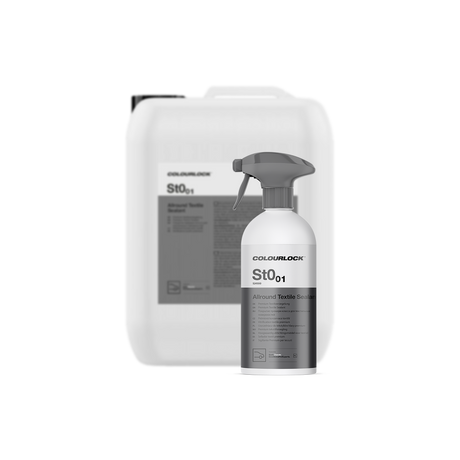
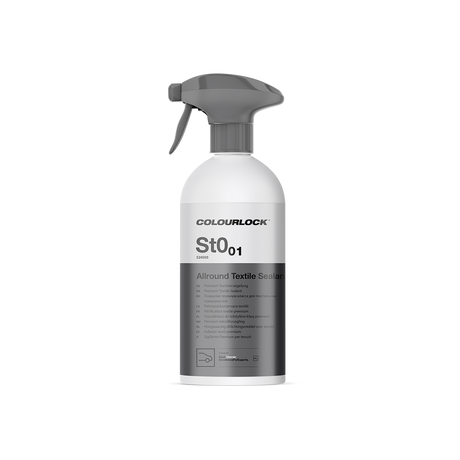
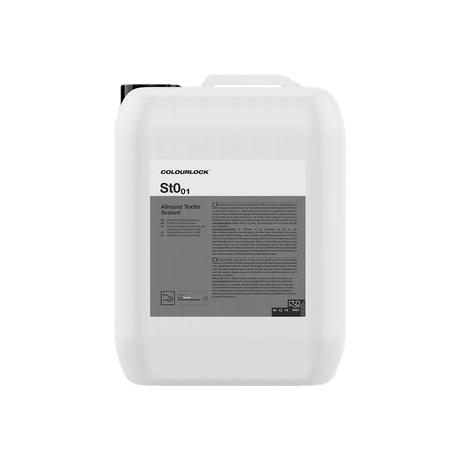
Allround Textile Sealant "St0.01" Premium Fabric Sealant
Optimal Textile Sealant for Long-Lasting Protection
Koch-Chemie × COLOURLOCK
COLOURLOCK "Leather Shield" Care Product for New Leather to Protect Against Wear
Protect leather from abrasion and maintain its matte finish
Koch-Chemie × COLOURLOCK
COLOURLOCK "Artificial Leather Protector" sealant for synthetic leather
Seal faux leather and protect it from abrasion
Koch-Chemie × COLOURLOCK
COLOURLOCK "Care & Waterproofing Oil" nourishing oil and waterproofing for smooth leather
Care and waterproofing for open-pore leather
What is the COLOURLOCK sealant & waterproofing range? Protective products that work before damage occurs: a polymer sacrificial layer for pigmented new leather, a specific formula for faux leather, a deeply penetrating waterproofing oil for open-pored smooth leather, and a fluorocarbon-free textile sealant for upholstery, Alcantara, and convertible tops.
Sealants & Waterproofing from COLOURLOCK is the protective product line from the leather specialist that has been supplying saddlers and detailers since 1995 and has been part of Koch-Chemie since October 2023. It acts before damage occurs: a wafer-thin sacrificial layer on pigmented new leather, a matched formula for faux leather and vinyl, a deeply penetrating oil for open-pored smooth leather, and a fluorocarbon-free sealant for fabric, Alcantara, and convertible tops. The surface is protected; conditioning happens elsewhere.
Pro-tip from Detailing1: If a sealant disappoints, it is rarely the product's fault and almost always the step before it. Skin oils, sunscreen, and residue from care products lie on the leather as an invisible film, and the sealant encapsulates this film—the result is exactly the greasy shine you wanted to prevent. Therefore, first clean with a leather cleaner, remove surfactant residue with a slightly damp cloth, and degrease the contact surfaces separately. Then work sparingly: a wafer-thin, even film; lint-free cloth; do not massage in; do not buff out. Anyone who saturates the surface will get white edges and sticky islands instead of protection when it dries.
Those who repair leather professionally know best which damage can be prevented. That is exactly where this product line comes from.
COLOURLOCK was founded in 1995 as a leather center in Rosdorf near Göttingen and from the beginning supplied saddlers, furniture workshops, and vehicle detailers—the very people who recolor worn side bolsters and rescue faded steering wheel rims. Since October 2023, the specialist has been part of Koch-Chemie in Unna; therefore, the line is branded Koch-Chemie × COLOURLOCK in our shop. The mindset has not changed.
This background explains why the protective products look different from the rest of the market. They don't promise shine or a water-beading film for show, but rather the preservation of the condition the material was in from the factory. For pigmented automotive leather, this means: silk-matte remains silk-matte, the feel remains the same, nothing feels smoother or more rubbery afterwards than before.
The second difference is the order of operations in your head. In professional detailing, protection is not the finishing touch after a wash, but a separate work step with its own preparation. Clean, degrease, repair or dye if necessary, then protect. Anyone who shortcuts this chain doesn't get half an effect, but none at all—and usually an optical problem on top of it.
And a third point that separates the brand from pure car care manufacturers: The focus extends beyond the car. Furniture, handbags, equestrian sports, outdoor shoes—the same formulas have been used for decades on leathers that become significantly older than any leasing vehicle. The substrate knowledge behind it is broader than a category for vehicle interiors might suggest.
There is no single interior sealant for everything. There is genuine leather, faux leather, open-pored natural leather, and textile—and each of them reacts to a different physical principle.
For pigmented smooth leather—the standard in cars—there is the Genuine Leather Sealant with COLOURLOCK "Leather Shield." An aqueous polymer dispersion crosslinks as it flashes off to form a flexible, transparent network that lowers the surface's coefficient of friction and closes the capillaries of the top finish. Important here: The film remains permeable to water vapor. A truly airtight sealant would trap heat and moisture, causing the leather to age faster.
Faux leather, vinyl, and PU-coated split leather require different chemistry. The Faux Leather Sealant with COLOURLOCK "Artificial Leather Protector" works with modified polyurethane polymers, because a synthetic matrix has no pores and therefore does not accept rehydration. The real task is different: slowing the migration of plasticizers from the material and lowering friction without anything floating on the closed surface and becoming sticky.
Both protective products for seat leather are bundled under Leather Sealant from COLOURLOCK if you want to compare genuine and faux leather side by side—in modern interiors, they are often found in the same seat anyway.
Open-pored and natural smooth leathers cannot tolerate a film at all. On them, a polymer layer hardens unevenly and clogs the pores. For this, there is the Leather Oil & Waterproofing with COLOURLOCK "Care & Waterproofing Oil": an oil-fat combination that diffuses into the fiber structure and makes the capillaries hydrophobic from the inside. Water beads up because the leather is saturated—not because there is a layer over it.
And everything textile—fabric upholstery, carpet, trunk, Alcantara, fabric top—gets the Textile Sealant with the Allround Textile Sealant "St0.01." It lowers the free surface energy of the fiber so much that the contact angle of a drop rises significantly above 90 degrees and liquid rolls off instead of soaking in. Incidentally, it is the first COLOURLOCK product to carry the alphanumeric Koch-Chemie nomenclature and was developed in Unna—the synergy product of the acquisition.
We intentionally treat protection and conditioning as two separate categories. The reason is not catalog logic, but physics.
Conditioning products soak into the leather's capillaries and work there: replenishing oils, softening, and providing UV absorbers to prevent fading. Sealants do the opposite—they remain on top and absorb mechanical stress. One keeps the fiber supple; the other keeps the surface intact. A product cannot do both simultaneously because it must either penetrate or form a layer.
This leads to a practical rule that surprises many: For young, pigmented leather in the first few years, protection is the right answer, not conditioning. The finish is still intact, the fiber is still saturated—what is missing is abrasion protection. Only when leather becomes older, drier, and more porous does the ratio shift, and conditioning from COLOURLOCK takes the lead role. By the way, the same applies consistently to the UV aspect: COLOURLOCK "Leather Shield" does not provide UV protection; the conditioning milk does that.
Where the order is reversed, we regularly see the result in inquiries: conditioning milk applied thickly to modern, sealed seat leather. It cannot soak in—neither through the pigment layer nor the protective layer—and remains as a sticky film that immediately attracts dust, dog hair, and lint. The seats then don't feel conditioned, but sticky. If you want to do both, the rule is: clean, seal, let it flash off, and only apply conditioner where the leather actually absorbs it.
With faux leather, the separation is even sharper. There is simply nothing to nourish there. Anyone who "conditions" faux leather is applying grease to a synthetic surface that will never absorb it—protection is the only sensible measure here.
Preparation determines the result, and more significantly than the choice of product.
On leather, this means: first work with a suitable cleaner from the cleaning range of COLOURLOCK, give the foam about 45 seconds to work instead of scrubbing with pressure, and only use soft brushes. Hard household brushes flatten the fine grain of the finish—the leather will shine greasy permanently afterwards, and no sealant will reverse that.
Then remove the surfactant residue with a slightly damp cloth and treat the contact surfaces with the Degreaser from COLOURLOCK. Only on a degreased surface will the polymer bond with the leather surface instead of the skin oils on top of it.
The application itself is unspectacular and should stay that way: wafer-thin with an applicator or lint-free cloth, in overlapping passes from seam to seam, working quickly. Do not massage in, do not buff out—friction while still damp destroys the even film formation. At normal room temperature, the surface flashes off in a few minutes. On the driver's seat, refreshing every three to six months is worth it; on back seats and door panels, six to twelve months is enough.
Textile has its own ground rules. The fabric must be clean to the fiber, surfactant-free, and completely dry—the Upholstery, Textile & Alcantara Cleaner is the right preparer for this. The sealant is sprayed on or worked in with a microfiber sponge in a cross-hatch pattern, and then it needs rest: up to 24 hours to cure without water and without stress, at an ambient temperature of 10 to 40 degrees Celsius.
We know from our inquiries that this specific point is the most frequently ignored—anyone who seals in the evening and gets in during the rain in the morning is testing a layer that isn't even finished yet.
A detail that is increasingly relevant in everyday life in German-speaking countries: The St0.01 is designed for pump sprayers and sponges, not aerosols. Fine spray mist from a can is respirable, and especially those who regularly work in enclosed halls notice the difference. Always ventilate the interior well, regardless of the product.
A protective layer postpones wear; it does not eliminate it. These limits are clearly definable.
It does not help against UV-related hardening and shrinking. This requires deeply penetrating conditioning with antioxidants and UV absorbers—a sacrificial layer on the surface doesn't even reach the fiber underneath. Likewise, it does not protect against deep scratches from jean rivets, keys, or dog claws. Its flagship discipline is the fight against micro-abrasion and dye transfer—one should not expect more from it.
Products are certainly not interchangeable. We tested the waterproofing oil on densely coated new leather: It simply doesn't absorb; it lies on top as a film and binds dust. Conversely, a film-forming sealant has no business on Alcantara or open-pored aniline leather—it creates stains and dark edges that cannot be worked out.
On nubuck and suede, the same applies to the oil: It clogs the pile. If you are unsure about your material, test on a hidden area before treating an entire seat surface.
The most important distinction concerns repair. A sealant does not fix a color. Anyone who has tinted or repaired leather needs a genuine polyurethane clear coat with crosslinker as a finish, which binds the pigments and sets the gloss level—the professional way via Top Coat & Finish from COLOURLOCK, applied with a spray gun. COLOURLOCK "Leather Shield" only goes on top afterwards, as a maintenance layer applied with a cloth. The other way around makes no sense: A Top Coat is not a product for the quarterly care routine.
And one compromise compared to the rest of the market should be stated openly. Ceramic leather sealants based on SiO2 last significantly longer—sometimes up to twelve months—and are more chemically resistant. In return, they more frequently change the haptics: The leather becomes noticeably smoother, and a fine gloss often remains on matte OEM surfaces. The polymer approach of COLOURLOCK trades durability for original optics. If maximum durability is more important to you than the factory finish, a ceramic coating is the more honest recommendation.
The fastest way to a decision is through the material, not the vehicle age.
Pigmented smooth leather, young and in good condition, light-colored interior, or lots of jeans on board: COLOURLOCK "Leather Shield," ideally right after delivery and with a few hours of rest to cure. The younger the finish, the more the abrasion protection contributes—on ten-year-old, dry leather, you get significantly more out of conditioning.
If the seat surface is faux leather, vinyl, or one of the vegan materials in modern electric cars, COLOURLOCK "Artificial Leather Protector" is the more suitable answer—technically closer to the substrate, especially for light-colored seats with a dye transfer problem. The most frequent question we receive regarding this category is exactly this distinction: Both protect against abrasion and color transfer, but each belongs on its own material.
Open-pored, natural, or heavily used smooth leather—classic car seats, saddlery, sturdy bags, outdoor shoes—get COLOURLOCK "Care & Waterproofing Oil," sparingly and in several thin passes rather than one heavy application. Twice a year is a realistic interval for most applications.
Cloth seats, carpets, trunks, Alcantara, and fabric tops are covered by the Allround Textile Sealant "St0.01." For family cars with sugary drinks in the back, for dog owners, and for convertible drivers, this is the area with the greatest noticeable everyday benefit—not because of the beading effect, but because stains can be removed from the surface afterwards instead of setting as a ring. You can find everything else from the brand one level up: Everything from COLOURLOCK.
The thought that carries the whole category is the same as with repair: COLOURLOCK has been earning its money since 1995 restoring damaged leather. The protective products exist so that it never gets to that point. A layer that costs a few minutes every few months determines whether the driver's seat needs to be recolored in five years or simply cleaned.
Too much choice in Sealing & waterproofing by COLOURLOCK? Get help picking:
Daniel von Detailing1 |

Daniel von Detailing1 |

Daniel von Detailing1 |

Daniel von Detailing1 |

Daniel von Detailing1 |

Jasper von Detailing1 |

Daniel von Detailing1 |

Daniel von Detailing1 |

Daniel von Detailing1 |

Jasper von Detailing1 |

Jasper von Detailing1 |

Daniel von Detailing1 |