



Caring for car leather means caring for the coating
Most leather damage in a car doesn't come from neglect — it comes from well-meant care. Too much product, the wrong tool, grease on a surface that can't take grease at all, and the seat ends up greasy instead of protected. The most common mistake happens in the first few seconds after you open the bottle: how much you pour. The reason comes down to how modern car leather is built.
Around 90 percent of all genuine-leather seats in production cars are pigmented smooth leather with a polyurethane top layer. Car leather care, then, is aimed at the coating, not at raw hide. This guide shows which type of product belongs on which leather, and what the workflow looks like that keeps that silky-matte, showroom-fresh look.
Modern car leather is painted leather
About 90 percent of all genuine-leather seats in modern cars are made of pigmented smooth leather that carries an opaque colour layer and a transparent polyurethane top coat.
That build-up explains almost everything that can go wrong in the care routine. The tanned hide is dyed all the way through, then a pigment layer hides natural scars and irregularities, and right on top sits the top coat — a wafer-thin PU clear coat, much like the clear coat on the bodywork. What that means for you: you're caring for a sealed plastic surface, not open hide. It has to shrug off UV, temperature swings, denim rub and spilled drinks, which is exactly why the car industry engineered it this way.
From that follows the single most important takeaway of this guide: thick leather greases and home remedies barely get through this top layer. They sit on top as a film, pull in dust and leave the seat greasy. What actually gets in are water-based emulsions with molecules small enough for the micro-pores of the coating.
The real enemies of the leather, meanwhile, work from the inside and from above. Over the years, residual moisture and plasticisers escape through the pores, the material hardens and cracks along the fold lines. At the same time, UV light bleaches the colour pigments. So care means one thing: top up the humectants and renew the UV protection before the material starts to go brittle.
Just how tough the conditions are shows in the carmakers' own spec sheet: a seat parked behind glass in summer hits 60 degrees and more in no time, and in winter the same surface drops below freezing. That's why the car industry tests seat leather for abrasion, light-fastness and hydrolysis resistance before it ever reaches the production line. That toughness is why cared-for car leather easily lasts 15 years and more — while neglected leather cracks along those same fold lines after five.
Leather grease, balm and emulsion aren't the same thing
Leather grease belongs on open-pored saddles, balms on living-room furniture, and coated car leather needs a water-based care emulsion with UV blockers — anything else just sits there as a film.
Classic leather grease is made for untreated, open-pored leather: riding saddles, old shoes, aniline furniture. There, the heavy lipids sink deep in and keep the collagen fibres supple. On the PU coating of a car seat that grease has no chance of soaking in — it stays on the surface, shines and grabs dirt. Leather balms and care milks from the DIY store work with much the same oils and give you exactly the wet look you don't want on car leather.
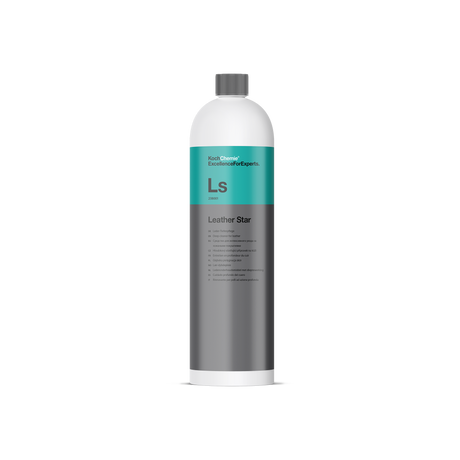
A modern care emulsion works differently. Koch-Chemie Leather Star "Ls" uses volatile hydrocarbon carriers in the C10 to C13 range that shuttle cosmetic esters through the micro-pores of the top layer down to the fibres, then flash off without leaving a trace. In plain terms: the care goes into the leather instead of onto it. What's left is a colour-deepening, silky-matte, factory-fresh finish — plus active UV blockers against fading.
If you're after maximum dirt resistance and don't care about re-oiling, there are also SiO2-based leather sealants alongside. They lay a protective film on the coating, but they don't feed the material underneath. For everyday use the rule is simple: if you want the leather to look and stay like new, the emulsion is the standard. And even with a sealant on top, cleaning is still non-negotiable.
And the home-remedy crowd? Washing-up liquid, vinegar water and dashboard sprays turn up in every other money-saving video — all three strip or discolour the top layer and speed up the very brittleness you're trying to avoid. The popular melamine magic eraser is an abrasive trap on leather too: it acts like sandpaper and visibly scuffs the top coat. So the rule of thumb for car leather care is this: nothing goes on the seat that isn't explicitly formulated for coated leather.

First work out the leather type, then the product
Pigmented smooth leather takes the normal care routine fine, perforated leather calls for a light hand around the perforation rows, and Alcantara is completely off-limits for re-oiling emulsions.
The pigmented smooth leather from the first section is the standard case — if you drive a stock BMW, Audi or Mercedes, there's a better than 90 percent chance that's what you're sitting on. Perforated leather, the kind you get on ventilated seats, is just as fine to treat, but it needs a steady hand: product mustn't flood into the perforation rows, or it dries white in there. Open-pored aniline leather, by contrast, drinks it up on the spot — here you work quickly and sparingly.
Faux leather benefits from the routine too. The PU surface of a modern faux-leather seat ages under UV much like the top coat on real leather, and a question like "can I protect the faux leather in my GLC from the sun" reaches us regularly. The answer: yes, same products, same workflow — only the expectations differ, because faux leather has no fibres to re-oil.
One material group is out completely: Alcantara and suede imitations. The re-oiling emulsion mats the fine microfibre pile for good — velvety turns stringy, and no cleaner brings it back. How to handle Alcantara instead is covered in its own guide, Cleaning Alcantara without ruining the pile.
If you're not sure what's fitted in your car, two simple tests help. A drop of water that beads up and holds for minutes points to pigmented, coated leather; if it soaks in within seconds and darkens the spot, you're sitting on open-pored aniline leather. And before any new product, run a colour test on a hidden spot — say the lower seat bolster facing the door. If the cloth picks up colour, the pigment layer is already damaged and belongs on the repair track, not in the care routine.
Clean it, let it dry, then care for it wafer-thin
The pro workflow has two stages: pH-neutral cleaning, full drying, then 15 to 20 pea-sized drops of care per seat cushion — no more.
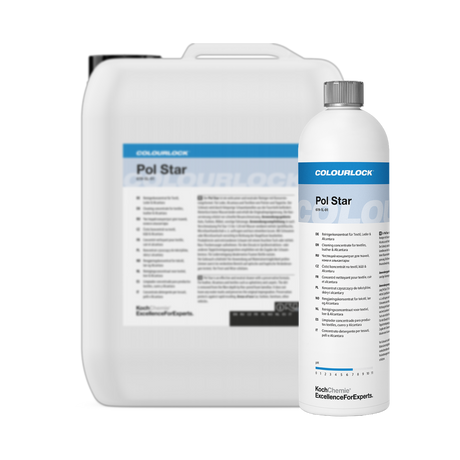
Stage one is cleaning, and it's not optional. Lay care onto dirty leather and you seal sweat, skin oils and grime in under the emulsion. COLOURLOCK Pol Star works as a pH-neutral cleaner for textile, leather and Alcantara: foam it up, work it in with a soft brush, wipe it off with a damp cloth. Only use microfibre with no pressure here — under pressure its split fibres act like the finest sandpaper on the top coat.
Then comes the most-skipped step: let the leather dry all the way through. Damp fibres swell and won't take care product. Temperature matters just as much — on cold seats the emulsion spreads badly and won't soak in. So in winter, heat the cabin first, then care for the leather.
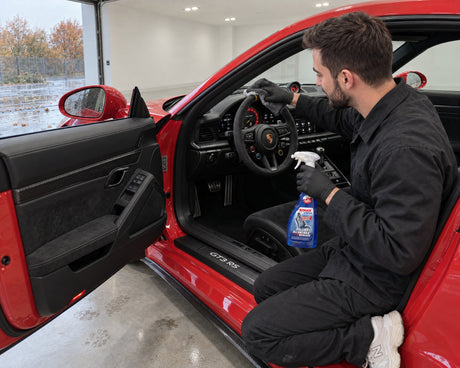
Stage two is the care itself, and here the amount is everything. Shake the bottle, put 15 to 20 pea-sized drops on an applicator like the Application Pen, and work it in wafer-thin with circular motions. A white haze right after you lay it down is normal and disappears on its own as it soaks in. After 5 to 10 minutes, buff off the rest with a dry cloth like the Pro Allrounder Towel, no pressure — only then does the silky-matte factory look come through. Around 100 millilitres cover a complete interior, so one litre does about ten.
Three details decide the result. First: before anything else, vacuum with the brush attachment — hard nozzles and loose sand otherwise leave scuff scratches in the coating. Second: really shake the bottle before every use, because the emulsion separates into its phases in storage, and unshaken you only get the carrier on the seat. Third: never work in blazing sun — on hot leather the carrier flashes off before the active ingredients have soaked in, and you're left with streaky edges.

Four products cover the entire workflow
For car leather care, four products are enough: a pH-neutral cleaner, a care emulsion with UV protection, a microfibre applicator and a soft buffing cloth.
The centrepiece is the care product. Leather Star has now gathered 25 verified full-marks reviews on Trusted Shops, and the feedback lines up strikingly: buyers agree the emulsion cares without leaving a greasy shine, and that the 1-litre bottle lasts a very long time. One of them uses it on a designer sofa alongside the car seats — the manufacturer's approval names vehicles and furniture together on purpose.
For the cleaning stage before that, Pol Star is the obvious pick. It's one of the most-searched terms in our shop search, which is hardly a surprise: a cleaner concentrate that covers textile, leather and Alcantara replaces three separate products. Application Pen and Pro Allrounder Towel round out the setup as the tools for laying on and taking off.
If you want to dig deeper or compare, you'll find the curated selection in our leather care category — from the single product to the complete system.
To put the coverage in perspective: at the recommended routine of two to four care passes a year, a single litre of Leather Star works out to several years on one car — the 100-millilitre dose per interior is the limiting factor, not the bottle. With Pol Star, the concentrate logic comes on top: you mix it down depending on how dirty things are, so one litre of concentrate turns into many times that in working solution. Buy the two together and your car leather care is sorted for a long time.
Which approach fits which leather problem
Cared-for leather needs a thin refresh every three to six months, light seats with denim contact considerably sooner, and worn spots a repair rather than care.
It's an if-then question. If the leather is clean and intact, a care cycle of three to six months is plenty — on the daily-use driver's seat, lean towards the lower end; among detailers the rule of thumb of a light refresh every 5,000 kilometres does the rounds. If the surface glistens greasy or looks grey, cleaning comes first, then care. If you drive light seats in beige or cognac and wear jeans, the dye rub-off from the fabric shortens the interval noticeably.
Two cases no care in the world will fix. Where the colour layer is already rubbed away — the classic greasy-bald door pull or the sat-out seat bolster — only a repair with leather paint helps; that's what the COLOURLOCK leather care sets are for. And the steering wheel stays care-free on principle: cleaned yes, oiled never — a slippery wheel is a safety risk, not a care win.
That leaves the calendar. Summer is the hardest season for leather: UV load, heat, bare skin and sunscreen hit the driver's seat head-on, and in winter the seat heating dries the material out on top of that. Hang the routine on spring and autumn and you're automatically doing it right — what that looks like in detail is in our spring guide to leather care, and the right order for the whole interior is covered in the piece on interior cleaning.

For getting started, by the way, it doesn't have to be a complete kit. First time caring for leather? Start by taking stock of the driver's seat — that's where the leather's condition shows first, because getting in and out, denim rub and sun all come together here. If the bolster looks clearly duller or balder than the rear bench, that's your yardstick for how urgent it is. The rear bench of a family car often needs only half the frequency.
Detailing1 insight: What we see at Detailing1 again and again: over-dosing is the one mistake that makes a good product look bad. On a test car with perforated sport seats we once laid the emulsion on too generously — the result was white-dried perforation rows and a shiny edge along the bolster, and the rework took longer than the actual care job. Ever since, the fixed dosing rule stands: 20 pea-sized drops per seat cushion at most, on perforation a soft brush over the rows, and excess taken off firmly after ten minutes. Wafer-thin isn't the economy option — it's the only right one.
No time for the whole post? Get it summarized:
Add Detailing1 as a preferred source on Google