



Car leather care starts with knowing your leather type
A customer wrote to us last week about a small worn patch on his driver's seat. His car: a BMW Z4 M40i with Vernasca in ivory white. He knew the name from the configurator down to the letter — just not whether real leather, faux leather or something in between sits underneath. That is exactly where it gets decided whether the next clean helps the seat or costs you one.
Car leather is not sorted by colour or by brand, it is sorted by finish. Only once you know whether your surface is pigmented, semi-aniline, aniline, suede-type or faux leather can you pick a cleaner and a conditioner safely.
The trim name tells you nothing about the finish
Finish is everything that goes onto the hide after tanning: a primer, a pigment layer and a clear polyurethane top layer. The trade calls that last one the topcoat, and it is the real shield on your leather. What that means for you: in a car you almost never treat the hide itself, you treat a wafer-thin plastic skin over it — and that skin decides what your cleaner does.
How thin it actually is surprises most people. The topcoat on car leather measures 5 to 20 microns. A sheet of copier paper sits at around 100 microns, the clear coat on your bonnet at 30 to 60. Under DIN EN 15987 the whole colour and lacquer build may reach 0.15 millimetres at most, otherwise the material cannot legally be called leather anywhere in Europe. So the shield on your seat is thinner than the one on your wing.
Carmakers sell their upholstery under trade names, and those names hide the material class. Vernasca is heavily pigmented and embossed real leather, Merino a fine full-grain hide with a far lighter finish. Sensatec, Sensafin and Veganza are faux leather, even though two of them feel richer than plenty of genuine hides. If all you know is the configurator name, you cannot make a care decision from it.
So we do that translation for you. The table maps the common names from model years 2015 to 2026 onto their real material class. It does not replace a test on the car — trim lines change, and in plenty of cars real leather and faux leather sit side by side in the same cabin, hide on the cushion and synthetic on the bolster. What it gives you is the first hunch, which you then check in the next step.
| Maker | Trade name | Material class | What that means for care |
|---|---|---|---|
| BMW | Vernasca | pigmented real leather | tough, a mild cleaner is enough |
| BMW | Merino | full-grain hide, lightly finished | more delicate, go easy on water |
| BMW | Sensatec, Sensafin, Veganza | faux leather | rub protection, not re-oiling |
| Mercedes-Benz | ARTICO | faux leather on a fabric backing | UV protection against embrittlement |
| Mercedes-Benz | Nappa | full-grain real leather | thin pigment layer, work gently |
| Audi | Milano | pigmented real leather | everyday-proof, cleans easily |
| Audi | Valcona, Feinnappa | natural grain, light finish | more absorbent, test spot required |
| Porsche | Clubleder | semi-aniline | open-pored, no standard cleaner |
| Volvo | Nordico | faux leather on a recycled backing | treat it as faux leather |
Five material classes, five completely different tolerances
Pigmented leather is the normal case in a car. Primer, an opaque colour layer and the topcoat close the pores far enough that the surface is effectively sealed. In that state the leather no longer breathes the way an untreated hide does. In practice: a conditioner does not sink into the core here, it keeps the topcoat supple. Anything meant to soak in deep inevitably sits on top as a film.
Semi-aniline carries only a microscopically thin pigment. It looks more natural but takes up liquid slowly. Aniline leather has no covering layer at all: the grain is open, the hide looks warm and alive, and it pulls water, grease and dye straight into the fibre. Suede-type leathers like nubuck and velour are fully open-pored too, with a fine nap standing up instead of a smooth grain.
Faux leather is a woven backing with a polyurethane or PVC coating. To keep the material soft it carries plasticisers that are not chemically locked into the polymer. Over the years they migrate to the surface and evaporate — the trade calls it plasticiser migration. You spot it like this: that hazy film on the inside of the windscreen comes from exactly there, and the material goes brittle and splits on the bolsters.
Worlds lie between these five classes. A film of water that beads on pigmented leather and wipes straight off leaves a dark ring on aniline that stays once it dries. A cleaner that works completely unremarkably on faux leather can mat the nap of a nubuck panel. So the first question in any car leather care job is not which product, it is which material.
The way it breaks down across the German car parc makes it manageable: the big majority of seat coverings fall into the two closed classes, pigmented real leather and faux leather. Aniline and semi-aniline turn up mainly in the higher trim lines and in sports models, suede-type almost only where the maker uses it as a grip material on the wheel or the seat centre. Know both ends of the scale and you can place everything else.

A single water drop decides it in five seconds
The water drop test is the most reliable tool for identifying the material, and it costs you two minutes. On a hidden spot you put one drop of clean water on the surface and watch what happens. How it behaves over time separates open-pored from closed surfaces far more reliably than anything you can see, because modern embossing rollers fake a natural grain convincingly.
If the drop sinks in within zero to five seconds and the spot goes noticeably darker, you have aniline or a suede-type leather. If it stands as a bead at first and then slowly sinks after roughly 30 to 60 seconds, it is semi-aniline. If it still sits there unchanged after minutes and wipes away without a trace, you are looking at a closed top layer — pigmented leather or faux leather.
What matters is the limit of this test, and most guides stay quiet about it. It cannot tell pigmented real leather from faux leather, because both carry a dense polymer layer and react identically. For cleaning that is a side issue at first, both take the same mild chemistry. For the care step afterwards the difference does matter, because faux leather needs no re-oiling, it needs rub protection.
Run the test where a possible mark stays out of sight: under the seat, on the underside of the cushion or on the back of the backrest. And do it in more than one place. In plenty of cars from the last ten years the real hide sits only on the contact faces, while bolsters, backrests and headrests are faux leather. A single test point will send you down the wrong road.
The first time round this feels fiddly, and that is part of it. Three test points including drying time take you about five minutes — once, because the answer holds for that car from then on. Note the result in the glovebox or on your phone. After that the product decision takes ten seconds, and you never stand in front of the seat guessing with a bottle in your hand again.
The seam edge and your fingernail settle the rest
If the water test leaves the real-versus-faux question open, look at the cut edge. Pull a seam on the bolster slightly apart or look into a perforation hole of the seat ventilation, ideally with a loupe. Real leather shows an irregular, wildly matted fibre structure in there. Faux leather shows a neatly woven backing grid that appears at the edges as fine pale threads.
The fingernail test adds to that on open-pored hides. Run it across aniline or waxed leather under light pressure and it leaves a lighter track straight away, because the waxes in the pores get pushed aside. The scene calls that the pull-up effect. If the track disappears when you rub over it with a warm fingertip, the case is closed: open-pored real leather. On pigmented leather and faux leather nothing happens at all.
Once the material class is settled, the same chemical guardrail applies to all of them. Leather is deliberately set slightly acidic during tanning, to a pH of roughly 4.5 to 5.5. In that band the collagen is stable. Alkaline cleaners from pH 8 upwards split the bonds in the protein, a process called alkaline hydrolysis. Day to day that means: the leather goes hard, grey and splits.
How brutal that difference is shows up in the rub fastness test to DIN EN ISO 11640, known in the trade as the Veslic test. A standard felt rubs across the surface under a defined load. Dry, car leather has to survive 1,000 to 1,500 cycles. Soaked in alkaline sweat solution the makers only ask for around 80. Same hide, same movement — and one eighteenth of the life as soon as the pH tips.

Our leather range sorted by material class
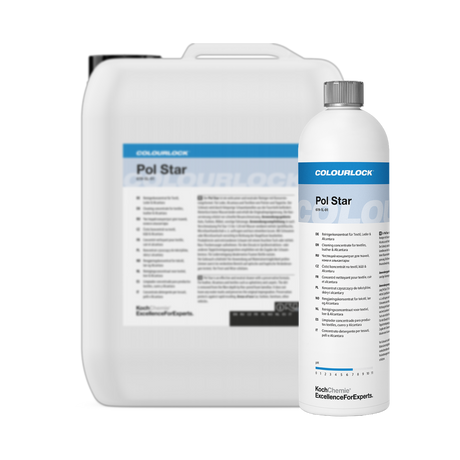
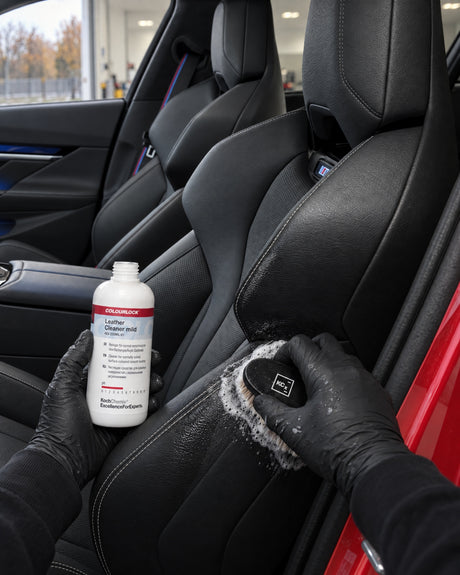
For pigmented smooth leather, the normal case, the COLOURLOCK „Leather Cleaner" (Mild) 1000 ml / 1 Liter is the everyday pick. It pulls grease, dust and rub-off with finely tuned surfactants without touching the matt factory look. If you have several materials in the cabin, grab the COLOURLOCK „Pol Star" Reinigerkonzentrat für Textil, Leder & Alcantara 1000 ml / 1 Liter: pH-neutral, for fabric, Alcantara and pigmented leather, dosed 1:20 on leather.
With Pol Star the maths are friendly: one litre of concentrate gives you about eleven litres of working solution at 1:10. More important than the yield is the limit, and we say it plainly. It is not meant for aniline and open-pored suede-type leathers like nubuck or suede. That is where the COLOURLOCK „Aniline & Nubuck Cleaner" 1000 ml / 1 Liter takes over, working with little water so the absorbent fibre never gets soaked.
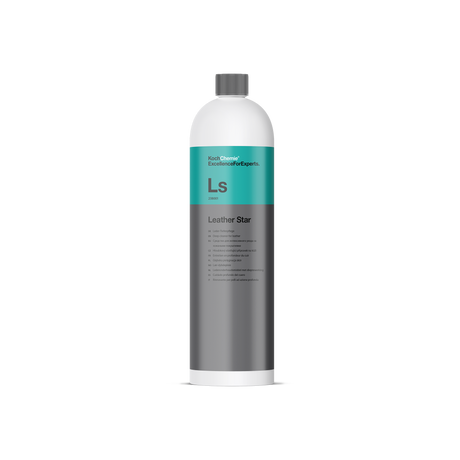
Care follows cleaning, and this is where real leather and faux leather finally part ways. The Koch-Chemie Leather Star „Ls" Lederpflege 1000 ml / 1 Liter carries cosmetic esters through the micropores of the top layer and leaves UV blockers behind without greasing anything up. Detailers consistently report that the 1-litre bottle lasts a long time — the maths behind it: about 100 millilitres per full interior, so roughly ten passes per bottle.
On faux leather, re-oiling does nothing, because there is no fibre to take anything up. What makes sense there is rub protection: the COLOURLOCK „Artificial Leather Protector" 1000 ml / 1 Liter lays a flexible film onto the surface, cuts the friction against clothing and slows denim transfer. You will find the full range in our leather care and leather cleaners.
A word on what we deliberately leave out. Leather grease, dubbin and mink oil come from an era when leather was open-pored — saddlery, heavy boots. On a closed polyurethane layer those pastes simply cannot get through. They sit on top as a film, attract dust and, through the friction of clothing, buff the seat to a greasy shine that factory-fresh car leather never had. The same goes for silicone gloss sprays.
Which product fits your leather
If the drop beads and the seam shows a fibre edge, you have pigmented real leather: mild leather cleaner, then care with UV protection, every three to six months. If the drop beads and the seam shows a woven backing, it is faux leather: same mild cleaner, but rub protection instead of a care emulsion afterwards. If the drop sinks in within seconds, it is aniline or suede-type — then the specialist cleaner only, and a test on a hidden spot.
The rhythm matters more than the product. Every two to four weeks a damp wipe and a vacuum of the seams is enough. That sounds trivial and it is the single most effective protection there is: sand and crumbs in the folds work like sandpaper on a 20-micron layer every time you get in and out. The deep clean with care afterwards then holds for three to six months, on the driver's bolster and the wheel closer to three.
Two things cost real substance in summer. Behind glass, dark leather seats reach 70 to 80 degrees, and that heat drives the breakdown of the polyurethane layer just as it drives plasticisers out of faux leather. Then there is sun cream: its titanium dioxide particles act mechanically like the finest abrasive, its solvents attack the topcoat chemically. That is exactly where the sticky pale handprints on the armrest and the wheel come from.
So the order is clear: identify the material, then choose the cleaner, then match the care to the class. How you actually work after that, with how little water and which brush stiffness, we wrote up in Ledersitze reinigen ist eine Frage des Leders nicht des Reinigers. If your bolsters are microfibre rather than leather, the road leads to Alcantara reinigen, ohne den Flor zu ruinieren.

Jasper's tip from the shop: The questions that reach us almost always name the trim and never the material — the last one a Z4 with Vernasca in ivory white and a tiny worn patch on the cushion. So I run the water drop test at three points rather than one: cushion, bolster, backrest. In most cars from the last few years at least one of them comes back different from what you expect, because the bolsters are faux leather. And the most expensive mistake happens before the cleaning anyway: skip the vacuum on the crumbs in the seam folds and you drag them across a layer thinner than a sheet of paper.
No time for the whole post? Get it summarized:
Add Detailing1 as a preferred source on Google