



Sealing before the rain takes more than one dry day
The weather app shows a dry day tomorrow, then three days of rain from Friday. For most people that is the invitation to quickly seal the car on Thursday. The idea is right, the arithmetic usually is not. What happens on your paint while you are long since off the clock has less to do with the rain than with the temperature and the dew point.
Depending on its class, a fresh protective layer needs somewhere between zero and twenty-four hours without liquid water. Which number applies to you is decided by the chemistry in the bottle. And in September every degree less stretches that time noticeably.
A dry day is not yet a rain-free window
Rain-free time means no liquid water on the paint. That window does not end when you shut the door, but only after twelve to twenty-four hours, depending on the product class.
In practice the term is almost always confused with dry to the touch. Those are two different states. During flash-off only the carrier solvents evaporate, which on a spray sealant in summer often takes less than a minute. The actual cross-linking then runs on for hours, invisibly, and that is exactly the phase in which the layer is vulnerable.
With SiO2 systems this is particularly clear. They cure through polycondensation: alkoxysilanes first react with air humidity to form silanol groups, which then link up with each other into a three-dimensional Si-O-Si network. Humidity is not a disturbance here, it is the reaction partner. Liquid water on the surface, on the other hand, upsets the balance. Full cure of such layers takes up to fourteen days.
For this week that means, concretely: Nordhorn sits at 14.5 degrees today under a clear sky, Thursday stays dry at 13 to 21 degrees, and from Friday the forecast holds three days of rain. Anyone starting on Thursday morning has roughly twenty-four hours until the first precipitation. Anyone starting on Thursday afternoon has maybe half of that.
That calculation is tighter in autumn than in summer. Between May and August, north-west Germany regularly offers five to seven dry days between two rain fronts; in September those windows shrink to one or two. That changes the product choice more than the temperature does. It is not the best durability that wins, but the layer that fits into the window you actually have. If a coating was the right call in summer, a wet-applied sealant is often the better call in September.
Rain on a fresh layer bakes minerals in
Rainwater is not distilled water. It carries dissolved minerals, fine dust and soot, and those stay behind in a still-soft layer as soon as the droplet evaporates.
Optically it starts out harmlessly. The water already beads, because the hydrophobicity at the surface arrives earlier than the strength underneath. The edge of the droplet still sinks into the still-permeable polymer matrix, and when the morning sun dries it off, the mineral ring sits in the layer for good. Neither a hand wash nor a quick detailer will get it out again. What does work is an abrasive polish, which removes the freshly applied sealant along with it.
The second class of defect is clouding and high spots. When moisture disturbs even cross-linking, areas with different light refraction appear that read as blotchy in the raking light of the low autumn sun. High spots are local excesses of material whose solvents could not escape and which cure as dark, oily-looking patches. Neither defect can be dissolved chemically afterwards.
And even if everything looks clean, early water contact costs durability. A coating designed for thirty-six months can collapse after the first salt winter because the cross-link density was compromised from the start. You will not notice that on the day of application, but in March.
How quickly such a mark stays depends on the water itself. In Nordhorn and across much of north-west Germany the water hardness sits in the medium range, so dissolved calcium and magnesium are plentiful. On a cured layer a droplet dries as a limescale ring on the surface and can be taken off. How to do that is in our article on water spots on car paint. On a soft layer the same ring gets locked in.

At 14 degrees cross-linking takes twice as long
The rule of thumb of reaction kinetics is simple: ten degrees less halves to quarters the speed of a chemical cross-linking reaction. In September that rule works against you.
What that means in practice can be worked out from any data sheet. If it lists a flash-off time of two minutes at twenty degrees, at ten degrees of paint temperature it becomes four to eight minutes. A full cure that is finished after seven days in summer stretches to fourteen to over twenty days at a steady ten to twelve degrees. The numbers on the bottle are laboratory values at ideal temperature, not September values.
On top of that comes the minimum temperature for application itself. Ceramic sprays usually want at least fifteen degrees, polymer sealants get by with ten, and hard wax also needs around fifteen so the paste stays workable at all. Thursday reaches those values easily in the afternoon; the early morning at 13 degrees does not everywhere.
What matters is not the air temperature but the temperature of the metal. A body that has stood outside through a cold night lags behind the ambient air for hours. Anyone who pulls it out of the shade at nine and seals it straight away is applying to a substrate that is still at ten degrees while the thermometer already reads eighteen.
An infrared thermometer costs little and settles that argument in five seconds. Measure the bonnet, the roof and a sill before you spray for the first time. If the readings differ by more than three or four degrees, the car has not equalised yet and you are working on three different substrates at once. That is exactly where the cases come from in which roof and bonnet look perfect while the doors stay blotchy.
Which layer fits into a 24-hour window
Not every protective layer is equally sensitive. The range runs from products with no rain-free time at all to coatings that need two weeks of peace.
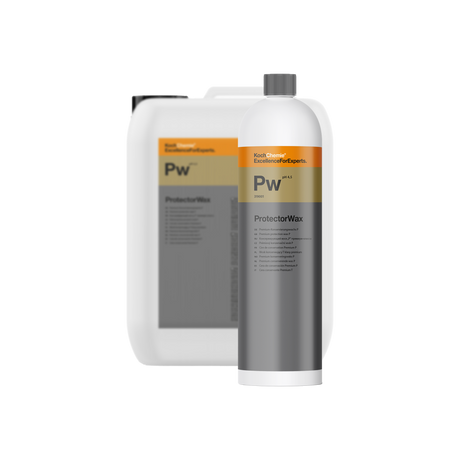
Least sensitive are water-activated wet sealants. The Koch-Chemie Protector-Wax "Pw" 1000 ml / 1 Liter belongs to this class: 30 ml of concentrate to one litre of water, sprayed onto the wet, freshly washed paint, then rinsed off thoroughly after two to three minutes of dwell time. Its pH of 4.5 makes the reactive components bond more strongly than a pH-neutral spray sealant would. After that the water film breaks up and the car largely dries by itself. There is no rain-free time here, because the layer already has its water contact behind it.
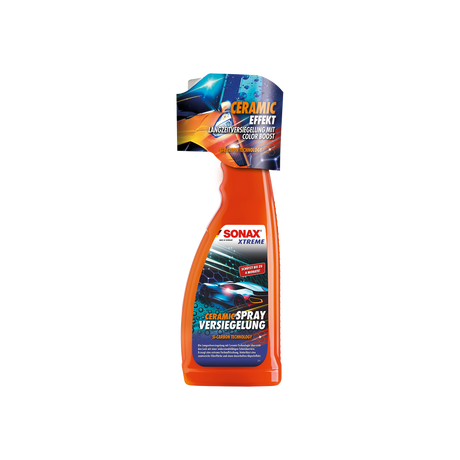
One step up sits the spray sealant. The SONAX XTREME Ceramic Spray-Versiegelung 750 ml builds a hydrophobic layer with its Si-Carbon technology that lasts up to four months, and asks twelve hours without liquid water in return. In the verified reviews at Trusted Shops users consistently describe it as easy to work with, which is worth more in a tight time window than the last tenth of gloss. Further options in this class are in our spray sealants.
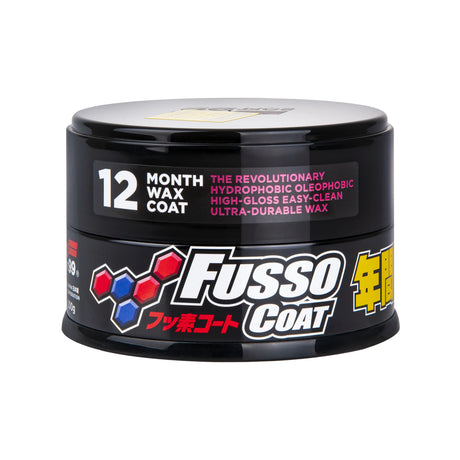
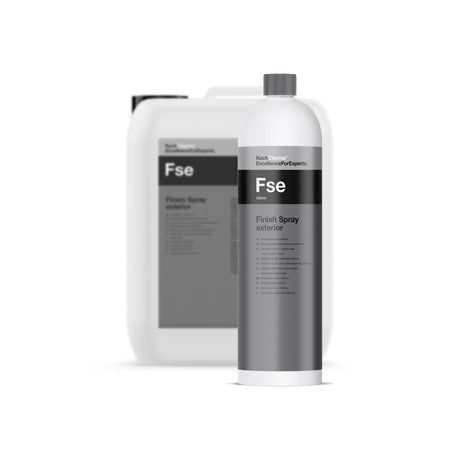
Hard wax behaves differently again. The Soft99 Fusso Coat 12 Months Wax Dark is water-repellent immediately after buffing off, because carnauba wax crystallises physically rather than cross-linking chemically. The carrier solvents still need around twenty-four hours to evaporate completely, and that is precisely why you must not apply a second layer during that time. It would re-dissolve the first rather than reinforce it. Our wax sealants give an overview of this class. For the in-between refresh after a wash, the Koch-Chemie Finish Spray Exterior "Fse" 1000 ml / 1 Liter is enough, averaging 4.67 stars across twelve verified reviews.
At the top of the sensitivity scale sit the true ceramic coatings. They deliver the longest durability and demand twelve hours of absolute dryness in return, plus around fourteen days until full chemical resistance, during which you should not wash with shampoo either. A product like that does not belong in a week with three days of rain, and with them the decisive work happens beforehand anyway — read up on it in our article on preparation before a ceramic coating.

Applying too thickly is autumn's most expensive mistake
The most common application error in the transitional season is not the wrong product choice but the quantity. At cool temperatures most people apply more, because that feels like more protection.
The opposite happens. At fourteen degrees the volatile carrier solvents evaporate slowly anyway, and a thick application extends the flash-off time disproportionately. The towel smears when you buff, and whatever you cannot remove cleanly cures as a high spot. Modern sprays are designed as wipe-on-wipe-off systems in which a minimal amount is enough. If the microfibre towel drags while you remove it, there was too much.
The second mistake is the cold substrate. It is not enough to heat the hall to twenty degrees if the car has just come in from ten-degree air. Sheet metal has high thermal inertia and stays cooler than the room air for hours. On cold paint the material turns viscous, and in the worst case an invisible film of condensation already sits between clear coat and sealant, preventing adhesion from the outset.
Then there are two classics that are easy to avoid. Anyone who only starts in the late afternoon and makes the final wipe at four o'clock loses the rain-free window to the dew that sets in from early evening. And anyone working in an unheated, damp garage blocks solvent evaporation almost completely at well over seventy percent humidity and ten degrees. A heat lamp is not the answer to that; it creates blisters in the film.
These four mistakes have one thing in common: they cost nothing extra, they only cost sequence. Put the wash in the morning, let the car warm through in the sun for twenty minutes afterwards, apply thinly and air the hall out once beforehand, and you have cleared all four without buying a single additional product. That is the difference between a layer that carries you through the winter and one that is soaking up water again in November.
The dew point decides, not the weather app
A freshly sealed car can get wet even on a rain-free night. The reason is radiative cooling: under a clear sky the body gives off its energy upwards unimpeded.
Work it through for a typical September evening. The air is at twelve degrees, relative humidity sits at eighty percent, and that gives a dew point of about 8.6 degrees. Without cloud cover the paint surface cools three to five degrees below the air temperature, so it lands at around eight degrees and therefore below the dew point. From that moment on, moisture condenses across the metal, and the dew carries the same airborne particles as the rain does.
The coatings industry has a rule for this, derived from corrosion protection under DIN EN ISO 12944 and directly transferable to car paint: the substrate temperature must sit at least three kelvin above the dew point. Keep that margin and you effectively rule out micro-condensation and the loss of adhesion that follows. Ignore it and you can do everything else right and still end up with a ruined layer.
From that calculation the plan for this week almost writes itself. Wash on Thursday morning, apply around midday at the highest paint temperature, use the afternoon for flash-off, and park the car under a canopy overnight so it loses its clear view of the sky. If you cannot do that, take the wet sealant and save yourself the arithmetic.
A carport helps more here than its thin roof would suggest. It brings no warmth, but it takes away the metal's clear view of the night sky and with it most of the radiative loss. Under a canopy the paint surface typically stays close to the air temperature on clear nights instead of dropping three to five degrees below it. For the twelve critical hours after application, that is often the whole difference.

Detailing1-Insight: We keep seeing cars whose sealant looks blotchy after four weeks even though the customer followed the instructions exactly. In almost every case the work was done in the late afternoon. On one of our test cars we reproduced it: same product, same paint, applied once at eleven in the morning and once at half past four. The morning side was clean the next day, the afternoon side carried a fine limescale haze from the night. So if you only have half a day, take the morning rather than the product with the better durability.
No time for the whole post? Get it summarized:
Add Detailing1 as a preferred source on Google