



Stop water spots before the rain bakes them in
The sun's out today, and the forecast has rain from Sunday on. That weather window is exactly what decides whether you're polishing baked-in water spots next week or looking at clean paint. Most people make the mistake of just letting the rain come.
Water spots on a car don't come from the water itself — they come from what's left behind once it evaporates. Combine the right products and use that 60-to-120-minute window before the rain, and you protect the paint well enough that droplets never turn into damage.
Why today is the day, not tomorrow
Before any rain there's a window between clear skies and the first drops where the paint is dry, cool and clean enough to take a protective layer. With today's setup, that window stays open until Sunday morning.
Clear skies with air temperatures between 7 and 13 °C mean a car parked in the shade sits at a paint temperature just over 10 °C, with under 80% humidity by the afternoon. That's no coincidence — it's the exact corridor almost every spray sealant is spec'd for by the maker. Manufacturers usually just call it the "application temperature": too cold and the carrier thickens, too warm and the solvent flashes off too fast and leaves streaks.
The OpenWeatherMap forecast has Sunday bringing cloud and rain, and Monday dropping to a low of around 3 °C — neither of which lets a pre-wash or a sealant work cleanly. Wait until the rain's over and you're suddenly fighting several things at once: the paint is wet, often already dotted with minerals, the air is saturated, and sealant grabs far worse. Prepping ahead is nearly always quicker than cleaning up after.
On top of that, the birch pollen index is currently sitting just under 8 out of 10 — high. Pollen pulls moisture out of the air, sticks to the paint, and turns into a tacky, mineral-laden film with the first rain. That mix is exactly what throws up the most stubborn water spots of the season every April.
Water droplets act like tiny lenses on the paint
A water droplet isn't just water. It carries dissolved minerals, dissolved gases and — over Central Europe these past weeks — fine Saharan dust and pollen particles on top. Once the water evaporates, all of that stays behind on the clear coat as a dried-on residue.
Tap water in northern Germany, which is what most driveway washes run on, sits at around 13 °dH — roughly 80 mg of calcium per litre. Berlin's tap water hits 14 °dH, firmly in the hard range, and anything above 14 °dH counts as hard under the German detergents law. So every 100 ml of dried droplet leaves behind about 8 mg of calcium carbonate plus magnesium carbonate plus trace minerals — a visible white-to-cloudy film.
Now let sunlight hit the still-wet paint at an angle and every droplet works like a little magnifying lens. The UV and heat get focused down onto the droplet's diameter, the paint under it heats up faster than the surrounding area, and the water evaporates there first. What's left is a concentrated ring of minerals sitting right where the clear coat was already under thermal stress.
With acid rain a second factor kicks in. Clean rainwater sits at a pH of about 5.6 thanks to dissolved carbon dioxide, but near industry and in Saharan rain individual drops can drop to a pH around 4. That's enough to microscopically etch the clear coat once the drop evaporates and the acid-mineral concentrate goes to work on one spot. A harmless water ring turns into an etch ring.

Type 1, 2, 3 — and the 90-minute pre-rain workflow
Detailing splits water spots into three depths. That classification decides whether you need 15 minutes or 5 hours to get the paint clean again — and with it, how much prevention is worth.
Type 1 is the deposit that only sits on top of the clear coat. You feel it when you run a wash mitt over the spot, and it lifts with a good pre-wash or a mild, slightly acidic quick detailer. Type 1 is what you see after every driveway wash when you're standing in the sun and don't dry straight away.
Type 2 starts when that mineral ring has been on the paint for more than a few hours and the first chemical reactions with the clear coat set in. You see it as a dull halo around the drop, and feel it as a slight dip if you really go looking. Type 2 needs an acidic water-spot remover, sometimes a light cutting polish. That correction quickly runs to four or five hours instead of 45 minutes of prevention.
Type 3 is the etched dish in the clear coat that only comes out with machine cutting and a heavy-cut polish. Here you lose clear-coat thickness, and every correction cycle shortens the paint's life. In Saharan-rain events with iron-oxide pigments, or rain with a pH below 5.6, Type 3 can form in just two or three back-to-back wet-and-dry cycles.
Before the rain you don't need a full detail. You need one layer the water can't cling to — and so no mineral deposits when it dries. The fastest route there in under two hours is a three-step run: pre-wash, contact wash and a spray sealant to finish. Step one: touchless foam pre-wash, ideally with Koch-Chemie Gentle Snow Foam on a foam lance, four to five minutes of dwell time, then rinsed off touch-free with the pressure washer. Step two: contact wash using the two-bucket method and a coating-safe shampoo. Step three: dry, then seal. The full workflow follows in the next two sections.
Which shampoo and which drying the paint can take right now
If the car's going to catch rain over the next few days, it pays to use a shampoo that pairs the wash with a top-up layer. Koch-Chemie Ceramic Effect Shampoo lays down a thin polymer layer as you wash — an extra layer the droplets can roll off, instead of leaving them as a mineral ring on bare clear coat.
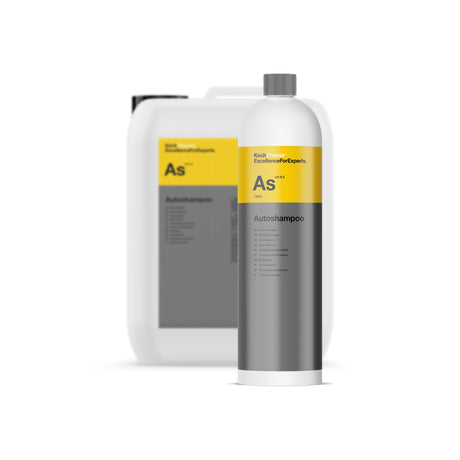
If you want to look after an existing sealant and don't need to build a new layer, go for the pH-neutral Autoshampoo As. At the correct dose of one cap per 10 litres of water, a one-litre bottle covers around 90 washes — at two washes a month, that's nearly a four-year supply. Numbers like that matter more in detailing than the price per litre: what counts is how much active product each wash actually uses.
Drying is the step where most water spots are born — not the washing itself. Work with a towel that's too small or too tight and you just push the droplets around the paint and rub the minerals in here and there. A high-pile microfibre drying towel like the Koch-Chemie Pro Drying Towel 950GSM actually soaks the water up instead of spreading it. If you want to read up on towel choice and blotting technique, we go into the long version in our post Drying your car without scratches.
The key when drying: don't rub, blot — dab the towel down so no leftover mineral film gets wiped into the clear coat. Shuts, trim and door jambs are part of the job too, even if they look unimportant at first glance. Water that stays sitting there runs back onto the paint with the first ray of sun and leaves pinpoint Type 1 marks right on top of the bonnet.

Which sealant makes sense right now, before the rain
For the next two to three weeks of protection, a spray sealant is plenty. Proper spray sealants lay a SiO₂ or polymer film on the paint and reliably keep water off for three to eight weeks depending on the product. Quick detailers, on the other hand, are mainly wax top-ups and protect for more like two to four washes — great after a wash, but not the same level of protection. Our spray sealant category guide breaks the sealant classes down in more detail.
The most direct route is Koch-Chemie Spray Sealant S0.02: after the wash, spray it onto still-wet paint, rinse briefly with water, dry off — done. Maker's durability is eight to twelve weeks, and it plays nicely with existing wax. If you want it faster, reach for Hydro Foam Sealant S0.03, which goes straight on through the foam lance as a wash-plus-seal in one pass. Both are in stock right now, and both handle equally well through the foam lance or the spray bottle.
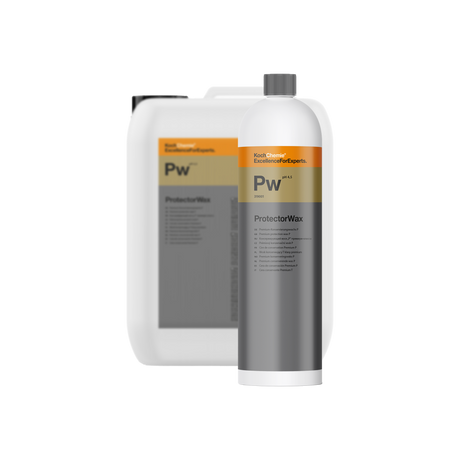
If you want a layer that lasts longer, take Protector-Wax Pw as a rinse-off sealant. A one-litre bottle covers about 50 washes, and in the northern German climate experience puts durability at four to six months — makers often quote longer, but the rough back-and-forth of dew, frost and road salt tends to land you at the lower end. That's more honest than any "up to twelve months" claim. For a quick top-up after the wash, Quick Finish Qf does the job, adding gloss and slickness on top — and it takes light Type 1 deposits off as you wipe.
You'll find the full run of current spray products for paint in the Quick Detailer category and the Paint Sealant category. Choosing between the two: a sealant protects, a detailer maintains — with rain on the way, go with the sealant.
The five most common mistakes — and what to do after the rain
The order of these mistakes matches what we most often see come in tagged as "burnt in" at the bench. One: washing in the sun. Sounds logical, but the paint's warm and the water evaporates faster than the microfibre can pick it up. Any droplet that isn't gone within a minute leaves a mineral ring. Shade or an overcast sky is a must — with today's conditions, that means working in the garage or up against a shaded wall.
Two: a clear-water rinse with the pressure washer and then leaving it to sit without drying. Reckon the paint will dry on its own and you build exactly the Type 1 deposits that turn into Type 2 in the sun. Drying is part of the wash, not something for the "I'll do it later" list.
Three: wax or spray sealant onto a wet mineral film. Skip the drying and apply straight over it and you lock the mineral ring in under the protective layer — the spot stays visible for the whole life of the sealant. Dry paint before you apply is not optional. Four: using the same microfibre cloth on the wheels first, then the bodywork. Brake-dust particles in the cloth pull minerals in like a magnet and spread them as the finest scratches plus clusters of water spots. Separate cloths per zone aren't detailing overkill — they're a cheap way to save paintwork. Five: letting sealant gas off in the midday sun. Spray sealants need cool, shaded conditions, otherwise the carrier film dries off too fast and leaves streaks of its own — which then become a magnifying glass for mineral deposits all over again with the next rain.
If the rain leaves marks anyway — typical with Saharan rain carrying iron pigments — there's a simple time rule. In the first 24 hours, Type 1 spots almost always come off residue-free with a mild quick detailer and a clean cloth. After 48 to 72 hours in the sun they turn into Type 2. So the plan is simple: run a touchless pre-wash that same evening, or the next day at the latest, and freshen up with Quick Finish Qf or whatever sealant you've already got on. Prevention costs 90 minutes at most; a later Type 2 correction takes four to five hours and costs you a layer of clear coat. That's what makes the pre-rain window one of the best time investments of the whole season.
Detailing1 insight: Before any pre-rain session we don't check the weather — we check the paint temperature with the back of a hand on the bonnet. If your hand feels the material straight away — paint between 8 and 15 °C — the window's open. If the paint's over 20 °C, give the foam a shorter dwell or move the car into shade. Our spray sealant always goes on in the last third of the coolest part of the day, never in the midday sun. Over a year, that saves more time than any faster spray bottle ever will.
No time for the whole post? Get it summarized: