


All-Purpose Cleaner for Cars: Which APC for Which Task?
You reach for the all-purpose cleaner, spray it onto the engine bay—and two weeks later, your freshly applied sealant shows uneven spots. What happened? Alkaline cleaners do exactly what they were designed for: they dissolve fats, oils, and organic compounds. Unfortunately, this also applies to carnauba wax and synthetic sealants if the dilution and dwell time are not correct.
By paying attention to the pH value and dilution when using an all-purpose car cleaner, you work faster, protect your paint longer, and buy the right product the first time. This guide shows which Koch-Chemie APC is made for which task and what the limits of each one are.
What an APC cleaner is and what it isn't
An all-purpose car cleaner, usually abbreviated to APC for All-Purpose Cleaner in detailing, is an alkaline universal cleaner with pH values between 11 and 14. It works through saponification: Alkalis hydrolyze ester and fat compounds into glycerin and fatty acid salts, which can then be rinsed away with water. This makes it effective for engine bays, floor mats, upholstery, door jambs, and coarse wheel pre-cleaning—anywhere where organic dirt refuses to be removed mechanically.
The saponification reaction is not magic, but chemistry. The higher the pH value, the more aggressive the hydrolysis, and the shorter the dwell time that is still safe on sensitive surfaces. The pH scale is logarithmic—a difference of one point corresponds to ten times the hydroxide ions. This is why dilution has more effect with APCs than the choice of brand. A cleaner at pH 13 diluted 1:50 is milder on the surface than an undiluted cleaner at pH 11.
What an APC is not: It is not a shampoo for regular car washing, because it is too alkaline for frequent paint contact. It is not a glass cleaner, because streak-free glass requires different surfactants. And it is not a wheel cleaner in the classic sense, because brake dust consists of iron particles that require an acidic pH to chemically bind. An APC dissolves the grease on the rim, the wheel cleaner removes the iron oxide particles. Both have their place, both are not interchangeable.
In a typical detailing workflow, the APC comes first. It prepares the surface so that all subsequent products adhere and work better—from shampoo to abrasive polish to sealant. Understanding this also explains why every all-purpose car cleaner needs a different dilution for different surfaces: The chemistry is always the same, but the dosage determines what it does to the protective layer.
Three alkaline cleaners from Koch-Chemie in direct comparison

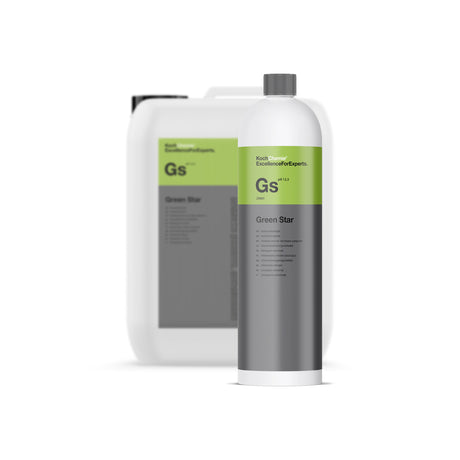
In the Koch-Chemie range, three alkaline cleaners cover the entire APC field. The Koch-Chemie Green Star GS works at pH 13 and is the best-selling universal cleaner in the detailing sector. Dilution 1:5 for intensive cleaning up to 1:50 for light tasks. Main areas of application are engine bay, floor mats, underbody, and initial wheel degreasing. Available only as a 5-liter canister, designed for regular commercial use.
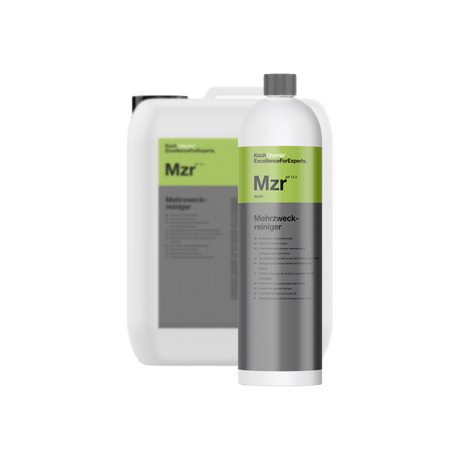
The Koch-Chemie Mzr is slightly lower at pH 12.5 and carries a Daimler approval: The product has passed approval tests on painted surfaces according to internal Mercedes-Benz protocols. Dilution range 1:5 to 1:50, suitable for interior, wheels, door jambs, and paint-safe cleaning equally. Available in a 1-liter bottle, making it the first choice for enthusiasts without a workshop operation.
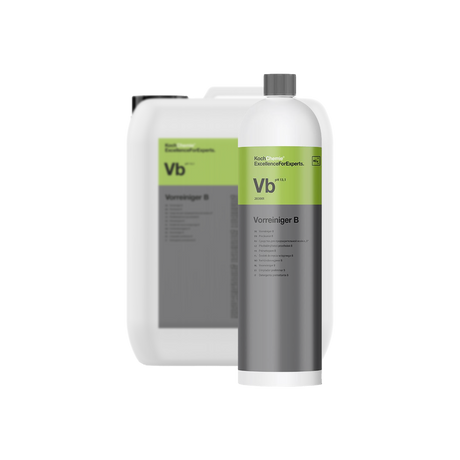
The Koch-Chemie Vorreiniger B has the highest value of the three with pH 13.1 and is VDA-compliant for contactless pre-washing. Dilution 1:30 to 1:50, always use highly diluted. It specializes in softening road and pollen dirt before the high-pressure washer and is not intended for direct paint contact.
A common misconception: Green Star at pH 13 acts more aggressively than Vorreiniger B at pH 13.1, even though Vb is 0.1 units higher. A difference of 0.1 on the logarithmic pH scale corresponds to a roughly 26 percent higher hydroxide ion concentration. In practice, with typical dilution levels, this difference is not noticeable. The decisive factor is the application scenario: Vb is used contactlessly and highly diluted, Green Star with direct contact on robust surfaces.
A look at the actual sales figures shows: Green Star is the most ordered cleaner in the Detailing1 range. Mzr follows immediately behind—a sign that many car detailers appreciate a handy all-rounder for interior cleaning in addition to the 5-liter workshop canister. Koch-Chemie has been developing car care chemicals for commercial workshop operations in Friedberg for decades, and the formulas are coordinated: Those who combine Mzr and Vb work with a consistent chemical system without unknown interactions.
Alkaline on sealants, what really happens
This is the point that is rarely openly discussed in care forums: Alkaline cleaners not only saponify oil and grease. At sufficiently high concentration and sufficiently long dwell time, they also attack the polymer and ester compounds of waxes and sealants. Carnauba wax contains myricyl esters and other fatty acid esters that are unstable towards strong bases—this is chemistry, not an exception and not a product defect.
In practice, this means: An APC at a concentration of 1:5 on freshly sealed paint—even if only a single spot was to be cleaned—can locally dissolve the protective layer. The damage is not immediately visible but becomes apparent during the next water test. The water no longer beads evenly, and after a few weeks, the sealant appears partially dull.
Ceramic coatings are more resistant than carnauba wax, but not immune. A correctly cured ceramic sealant usually survives a single APC contact with correct dilution undamaged. However, repeated cleaning with 1:10 on a ceramic coating demonstrably accelerates the degradation of the Si-O bond structure. Here too, the rule is: dilute strongly, let it dwell briefly, rinse immediately.
What to do if APC has already come into contact with sealed surfaces? Rinse immediately with cold water, wipe dry, and check the beading behavior. If the water no longer beads evenly, polish the affected area and re-seal. A single contact with higher dilution usually leaves no permanent damage, but it is a signal to adjust the dilution ratio for the next use.
The right dilution for every degree of contamination

No APC is used undiluted—this is neither necessary nor sensible. Dilution with water regulates the effective pH value and thus the aggressiveness on the surface. The same rough dilution levels apply to all three Koch-Chemie products, based on the contamination and proximity to paint.
In the 1:5 to 1:10 range, the APC works most strongly. Heavily ingrained engine oil, bitumen, floor mats after winter, underbody—these are classic applications for this concentration, exclusively on unpainted surfaces. Dwell time a maximum of three minutes, then rinse with cold water. Green Star and Mzr work equally well here; Vb is too good for this aggressiveness.
For interior cleaning on textiles, plastic, and rubber mats, 1:10 to 1:20 is sufficient. Short dwell time of one to two minutes, immediately absorb or vacuum. For light-colored upholstery and headliners, 1:20 is the safer choice, and a test in an inconspicuous area is essential—Mzr is the first choice here thanks to Daimler approval.
In the 1:20 to 1:30 range, pre-cleaning wheels before using wheel cleaner, as well as sill plates, door jambs, and lower body edges. Mzr is also the first choice here, because its Daimler approval proves its harmlessness on painted surfaces. For contactless pre-washing in the 1:30 to 1:50 range, Vorreiniger B is designed—VDA-compliant, immediately rinsable, ideal after pollen season and summer driving.
If you want to keep several dilution levels in parallel, label the spray bottles directly with the product and ratio—for example, "Mzr 1:15 Interior" and "Mzr 1:25 Wheels". This way, you grab the right solution without thinking when cleaning and avoid the common mistake of accidentally using the interior concentration on areas close to the paint.
When mixing, first put water into the spray bottle, then the cleaner—not the other way around, this prevents excessive foaming. Cold water is sufficient. Warm water up to 40 °C increases the dissolving power for stubborn oil stains but should only be used in paint-safe applications. For pre-washing the vehicle, a pump sprayer with two to three liters capacity is recommended: even application, no overspray on trim strips.
A rule of thumb: The closer to the paint and the fresher the protective layer, the more you dilute. If you are unsure, first test on an inconspicuous area such as a door sill or rocker panel, let it dwell for five minutes, rinse thoroughly, and then check the beading behavior. These five minutes can save you an expensive re-sealing in case of doubt.
Our Koch-Chemie APC selection for every task
The three products cover different user profiles. The Green Star in the 5-liter canister is the first choice for detailers and workshops with regular deep cleaning. Five liters, diluted 1:20, yield exactly one hundred liters of cleaning solution, which corresponds to about 30 to 50 vehicle cleanings. The canister also makes economic sense: the price per liter is significantly lower than similar products of comparable quality.
The Mzr in 1 liter is the all-rounder for enthusiasts who are looking for a single APC for interior, wheels, and exterior cleaning. The Daimler approval is not a marketing label, but means that the product has been tested according to Mercedes-Benz's strict internal approval standards and contains no ingredients that would long-term attack common automotive paints.
In practice, this means: Mzr forgives application errors that Green Star would not. Those who regularly maintain customer vehicles of different brands also avoid discussions about warranty claims if something is noticed on the paint—the Daimler approval is documented and legally sound, which makes a difference in case of warranty.
Vorreiniger B in 1 liter is the addition for contactless pre-washes, especially effective after pollen season and with summer dirt. One liter, diluted 1:40, yields exactly 40 liters of pre-wash solution—sufficient for an entire season for one vehicle. The combination of Mzr plus Vorreiniger B covers virtually all scenarios for private car detailers: Vb for the gentle contactless first step, Mzr for interior, wheels, and intensive cleaning.
Green Star is added when regular engine bay cleanings or professional applications are involved and the 5-liter quantity makes economic sense. Those who combine all three—as is standard in mobile detailing setups—have a complete APC system from one brand, without interaction risks between different manufacturer formulas.
When Green Star, when Mzr, when Vorreiniger B

The simple decision is as follows: For workshop level or regular deep cleaning of the engine bay, underbody, and floor mats, Green Star in the 5-liter canister is the right choice. Those looking for an all-rounder for interior, wheels, and paint-safe work who only want a single product on their shelf should opt for Mzr in 1 liter. For contactless pre-washing, pollen season, and gentle initial pre-cleaning without a brush, Vorreiniger B in 1 liter is made.
What all three have in common: They do not replace specialized products. A dedicated wheel cleaner, a pH-neutral shampoo for sealed paint, and a glass cleaner remain independent tools in the care routine. The right all-purpose car cleaner is the heavy-duty tool for the contamination phase before the actual care step begins—not the universal remedy for everything from the steering wheel to the rim.
A tip for the current season: In April and May, pollen count in Germany is at its annual peak. Birch, alder, and grass blossoms leave a yellow film that dries in the sun and makes paint and windows bead less effectively. Vorreiniger B diluted 1:40 as a contactless pre-wash before the hand wash step dissolves pollen residue without friction, reduces the risk of micro-scratches, and protects the paint. Due to the pre-soaking, the shampoo step then requires less mechanical pressure.
Daniel from Detailing1: “The most common mistake I see customers make: pouring Green Star from the 5-liter container directly into an empty spray bottle and spraying it undiluted onto painted areas. You don't see the effect on the paint immediately—but during the next water test, you notice: the sealant beads less effectively. The APC has cleaned, and in doing so, has also dissolved the wax layer. Dilution and immediate rinsing are not an optional recommendation, but a prerequisite."
No time for the whole post? Get it summarized: