



Clearing an oily film off the windscreen in two steps
It starts innocently enough: the first rain after a dry week hits, you flick the wipers on, and instead of a clear view you smear a milky haze right across the windscreen. The more you wipe, the worse it gets, and with the low summer sun behind it the road all but vanishes behind an oily sheen.
An oily film on the glass isn’t a wiper problem, it’s a thin layer of traffic grime and out-gassing plastics. Degrease it first, then polish with Ceroxid only if you need to, and you get clear, streak-free vision back in one go.
Why your wipers only smear in the rain
When the wiper blades smear instead of clearing, it’s almost always a wafer-thin film of grease or wax on the glass that the rubber just spreads around instead of pulling off. It’s exactly what the official German driving-theory test asks about.
Question 2.7.02 makes the point that smearing wipers signal a dirty windscreen, not necessarily worn blades. As long as that film sits on the glass you can fit new wipers as often as you like and they’ll keep smearing. Water doesn’t sheet off the film evenly, it tears into greasy streaks that close back over a second later and cost you your view exactly when you need it most.
Whether a film is really the culprit takes seconds to check. Run a clean finger over the dry outer glass: if it squeaks, it’s grease-free; if it glides quietly and feels smooth and soapy, there’s a layer on it. Looking through the glass towards a light gives it away too, because an oily film throws a rainbow-like pattern in backlight that clean glass never does.
The effect is nastiest in summer. At around 84 percent humidity right now and daytime highs near 30 degrees, the cooler inner face of the glass fogs up fast, and any film already there shows up straight away as a milky haze. Outside, meanwhile, traffic grime settles undisturbed through the dry spells, then gets switched on by the first shower and drags across the whole pane as one closed oily layer.
The upshot isn’t just annoying, it’s a safety issue. In backlight, on night drives and in the rain an oily film scatters light diffusely across the whole pane, and oncoming headlights turn into blinding stars. Your reaction distance stretches when you’re fighting a glowing haze at the decisive moment instead of having a clear view, and it’s exactly through the dark, wet months that this stacks up.
Two films, two causes: traffic outside, out-gassing inside
The layer on the glass comes from two completely different directions, and if you only tackle one of them you’ll wonder why the haze is back so fast. Outside it’s traffic film; inside it’s out-gassing.
On the outside you get a cocktail of soot, tyre wear, diesel soot and fine oil mists, the sort that hang in the air especially around industrial estates and busy routes. Add residue from some car washes, whose drying agents and waxes settle on the glass as a hydrophobic haze. That wax film is exactly what makes water suddenly bead into fat drops instead of forming a thin, running sheet.
On the inside the layer comes from out-gassing: plasticisers from the dashboard, door cards and above all from glossy cockpit sprays evaporate in the summer heat and settle on the cooler glass as an oily fogging film. Why the inner glass smears so quickly in summer and how to target that layer, we’ve covered in detail in our post Removing inner-glass film.
One special case makes it worse in hard-water areas. When rain or wash water dries on the warm summer glass, mineral limescale spots stay behind and bond with the oily traffic film into a particularly stubborn grey haze. That mixed layer is why some windscreens simply won’t come clear with glass cleaner alone and a second, more targeted step is needed.
In practice that means both sides need doing. A flawlessly degreased outer pane doesn’t help much if the inside fogs up again on the next heatwave, and vice versa. Only when both surfaces are grease-free does the smearing go for good, and at the end you’ll spot at a glance which side was the real culprit.

Degrease first, then polish, the two-step that actually lasts
Clear vision comes in two cleanly separated steps: first chemically degrease the loose grease and traffic film, then only work back mechanically with Ceroxid on baked-on residue. That order saves you the most work.
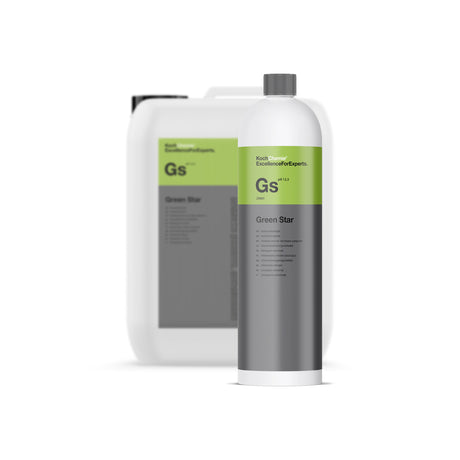
Step one is pure degreasing. A low-residue glass cleaner like THE FINISHER ClearView lifts skin oils, dust and road film and flashes off in a controlled way without leaving streaks, even in backlight. On a stubborn, properly greasy film it helps to go in first with a heavily diluted alkaline cleaner: as a high-alkaline concentrate at a pH between 12.5 and 13, Green Star literally saponifies oil, grease and wax and rinses them off. Always follow up with plain glass cleaner afterwards.
Work panel by panel and swap the cloth the moment it feels greasy. One soaked microfibre just shoves the dissolved film from one corner into the next. Two clean cloths, one to lift and one to buff dry, give a far better result than endless rubbing with the same rag.
The setting matters. Never work in blazing sun or on hot glass, because the cleaner dries on before you can pull it off and leaves exactly the streaks you’re trying to get rid of. A shady spot, a half-open hall or the early morning hours are ideal, because the glass is hand-warm there rather than hot and the product flashes off under control.
Step two is the exception, not the rule. If baked-on water spots, a grey haze or fine etching still sit in the glass after degreasing, a Ceroxid glass polish comes into play. It removes water spots, streaks and oxidation chemically-mechanically, exactly the damage a glass cleaner no longer touches, without you having to reach for laborious sanding. For large-area limescale haze from hard water or the car wash, the Waterspot Remover is the gentler choice, because it dissolves mineral deposits purely chemically and without abrasion.
Which products actually get the glass clear
You don’t need a toolbox for clean windows, just three products that work together: a glass cleaner for everyday use, an alkaline cleaner for the hard cases and a Ceroxid polish for baked-on residue.
The ClearView glass cleaner from the glass-cleaner range is the workhorse for ninety percent of jobs. The 500-millilitre bottle lasts for plenty of washes, because a windscreen only needs a few spritzes, and it works inside and out, which makes it the logical last step after every wash. Drive regularly and it’ll see you through the whole year.
For the oily exception, Green Star rounds out the set. As a concentrate it’s diluted right down and shifts even stubborn traffic and oil-mist film, the kind that settles around industrial estates. Mind the limit, though: on pH-neutral coatings, synthetic-leather trim or anodised parts an alkaline cleaner has no business without a spot test, but on bare glass it’s in its element. A high dilution is usually plenty, because the cleaner works through the alkali saponifying the grease rather than through sheer concentration, which makes it both economical and easy on materials.
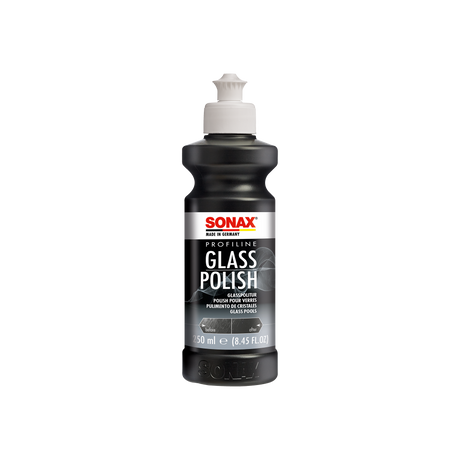
The Sonax GlassPolish in the 250-millilitre size closes the gap at the top end. Ceroxid works chemically-mechanically and pulls baked-on water spots and grey haze out of the glass that any spray cleaner is too weak for. Because a polish only goes on the affected spots, a small bottle lasts surprisingly long, and you’ll find the full range of glass care bundled in the Glass and Windows category.
On top of that come two things no cleaner replaces: clean microfibres and patience. Keep dedicated cloths for glass that have never touched wax or plastic dressing, because even traces of it lay down the next film. A tightly woven glass cloth for the final buff pulls off the last residue streak-free, whereas a fluffy all-purpose towel tends to leave lint on the glass.
The mistakes that make an oily film worse
Most stubborn streaks come not from too little effort but from the wrong products. Three mistakes crop up again and again on the forums and reliably make an oily film worse.
The first classic is washing-up water. A squirt of hand dish soap does cut the grease briefly, but it leaves surfactants and fragrances behind that form a new, even stickier film of their own. At the next rain it foams up slightly and the wipers smear worse than before. A low-residue glass cleaner exists precisely because it dries off without that residue.
The second mistake is rain repellent on dirty glass. A windscreen sealant seals in whatever lies underneath, the oily film included, then barely holds and smears twice as much. You only ever seal a freshly degreased, absolutely grease-free pane, the way we show it step by step in our post Applying windscreen sealant properly.
The third and most underrated mistake is on the inside: glossy, silicone-based cockpit sprays. They look good for a moment but gas off in the heat and lay down exactly the oily fogging film on the inner glass you’re actually fighting. Fog your dash right in front of the windscreen with a glossy silicone spray and you’re making your own haze.
A fourth mistake costs you not your view but the glass itself: dry-scrubbing a dusty film. Rub a cloth over a dry, sandy pane without pre-washing and you grind fine grit into the glass like sandpaper, leaving exactly the micro-scratches that set every wiper smearing anew later on. Before wiping, always wet the glass down first so the dirt floats and doesn’t scratch.

How to keep the film from coming back
Preventing an oily film is easier than removing it, and it hinges on two decisions: the right interior care and a regularly degreased, sealed windscreen.
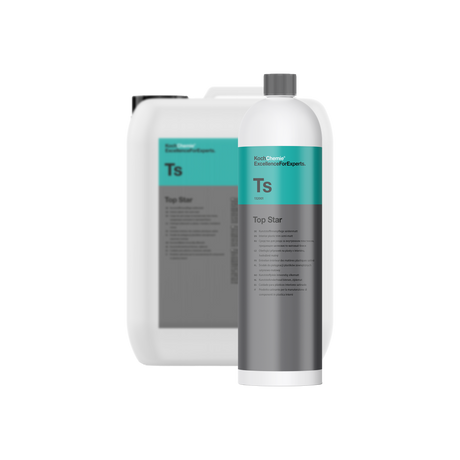
The most effective lever against the fogging film sits in the interior. A silicone-oil-free interior dressing like Top Star cares for plastic and rubber to a satin-matt finish, with UV protection and an antistatic effect, without the out-gassing silicone oils of classic cockpit sprays. That silicone-oil-free formulation is exactly why later glass and paint work is no longer disrupted, and why the inner glass stays clear.
Outside it pays to keep a rhythm: after every wash, go over the windows with plain glass cleaner so traffic film never gets a foothold. A windscreen sealant afterwards keeps water beading and dirt from clinging, and noticeably shortens the next clean. The order stays key: degrease first, then seal, never the other way round. Make that short extra step a habit and you’ll spare yourself the laborious Ceroxid polish almost entirely across the season, because the film never gets the chance to bake in.
And if the haze does come back once, say after a long motorway run through an industrial area, you now know it’s not a wiper problem. A quick pass with the glass cleaner over both sides and your view is clear again, without you despairing over the wiper blades.

Jasper’s tip from the shop: When our own demo car sat in the showroom in Nordhorn through a summer heatwave, the inner glass had gone milky after two weeks even though everything outside was freshly degreased. The culprit was a glossy cockpit spray from the previous owner. Ever since, we only run silicone-oil-free interior care, and the fogging film has never shown up again. My tip: do the inner glass first with plain glass cleaner on a degreased cloth, before you even start outside, then you’ll see straight away which side is really causing the haze.
No time for the whole post? Get it summarized:
Add Detailing1 as a preferred source on Google