



Wash Your Car Right, Without Swirls
One of the most common questions we get before the first warm wash weekend almost sounds shy: does a grit guard in the bucket really stop scratches, or am I just telling myself that? The honest answer is that it isn't the shampoo that decides whether you get swirls, it's the order in which you go at the paint. If you want to wash your car right, you win the fight against micro-scratches before the wash mitt ever touches the paint.
Swirls are fine, circular micro-scratches in the clear coat that almost every car picks up over time. They come from dirt particles rubbing against the paint, not from the shampoo. A touchless pre-wash and the two-bucket method cut that friction risk down drastically.
What swirls are and why almost every car gets them
Swirls are circular micro-scratches in the clear coat that show up in direct sunlight like a fine spider's web running across the bonnet. They don't sit in the paint itself, but in the top layer of clear coat that protects your colour.
In the detailing scene they're kept apart from deeper RIDS, the random deep isolated scratches, and from holograms, the hazy streaks a badly handled polisher leaves behind. Swirls are the mildest and by far the most common type. That's exactly why we're talking about them: they're the only paint damage you can avoid almost completely through your wash technique alone.
What matters is the mechanics behind it. Every speck of dust, pollen and brake dust on the paint is harder than the clear coat underneath. Drag that particle across the panel with your wash mitt and it acts like fine sandpaper. It isn't the pressure of your hand that makes the scratch, it's the grit you push across the paint.
In June there's a seasonal amplifier on top. The Google Trends curve for pollen on cars is currently well above the yearly average, with spring as the clear peak. Pollen film is sticky and binds dust that would otherwise dry off and blow away. Wipe it off dry and you're basically pushing the swirls into the paint yourself.
Swirls stand out most on dark paint and in low sunlight or under an LED lamp. They're just as present on light colours, they simply show less because the contrast is missing. That fools a lot of drivers of a silver or white car into thinking their wash technique is fine. In reality the damage just builds up more invisibly. So washing your car right pays off whatever the paint colour, even if the effect only shows at the next coat of protection or when you come to sell.
Why most scratches happen during the wash of all things
The uncomfortable truth: most swirls don't come from the automatic car wash, they come from the well-meant hand wash at home. The classic culprit is the old sponge in a single bucket that picks up the dirt it just loosened every time you dunk it.
We hear this worry all the time when people ask us for advice, often as a question like "Can a cleaner cause scratches on dusty paint?". The answer is yes, if the dust stays dry and gets spread around mechanically. A mid-range paint job has a clear coat of only about 40 to 50 microns, thinner than a human hair. Everything you notice as gloss or as a dull haze plays out inside that wafer-thin layer.
That's why the cheapest swirl removal is the one you skip entirely. Once the scratches are in there, the only thing that helps is a clean paint prep followed by a machine polish that shaves off clear coat. A wash costs you twenty minutes; a polish costs half a day and a slice of your finite clear coat. In AI search results, "polish for holograms and swirls" is one of the most-asked questions about paint. So most people only go looking for the fix once the damage has long been done.
This is exactly where washing right comes in. It isn't about rubbing more gently, it's about getting the abrasive dirt off the paint before anything rubs at all. That's technique, not muscle.

Steps one and two: touchless pre-wash with snow foam
The most effective swirl prevention happens with no contact at all. A thick foam pre-wash softens the heavy dirt and rinses away a big chunk of the abrasive particles before the mitt ever comes into play.
Step one is the pre-wash. Lay the Gentle Snow Foam on thick through a foam lance, working bottom to top, let it dwell for about five minutes and never let it dry on. During that time the foam creeps under the dirt and breaks its grip on the paint. Then rinse thoroughly top to bottom with clean water. This step alone lifts most of the grit off the paint without a single touch.
Step two is prepping the buckets. You need two: one with the wash solution, one with clean rinse water. The rinse bucket gets a Grit Guard Schmutzsieb, a grate insert at the bottom. You rub the mitt out against it, the loosened sand sinks below the grate and stays there. That way you don't pick any dirt back up next time you dunk. That's exactly the answer to the common question of whether a guard like that really stops wash scratches: it keeps the abrasive sand away from the mitt.
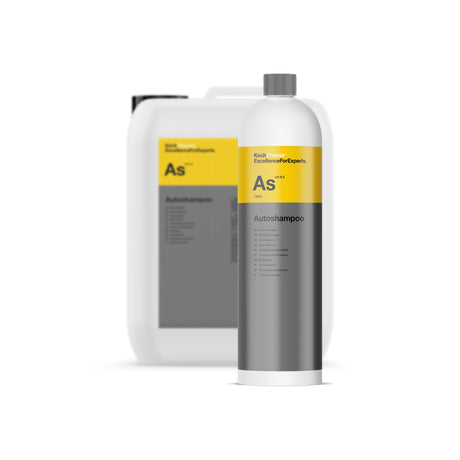
For the wash solution, mix the Autoshampoo As at 1:15, so about 65 millilitres to 10 litres of water. At pH 9 the shampoo is slightly alkaline. That means its anionic-nonionic surfactant blend wraps around grease and dust particles and holds them in suspension instead of just pushing them across the paint. For you that means the dirt floats in the water film and glides off rather than scratching. The balance is what counts: As is strong enough for pollen film and road dust, yet mild enough to keep an existing wax or sealant alive through the season.
Steps three and four: the two-bucket method and gentle drying
Step three is the actual wash with the two-bucket method. You always work top to bottom, because the lower area around the sills carries the most and the coarsest dirt. The roof is cleaner than the bottom edge of the door, so you start up top.
Guide the plush microfibre wash mitt in straight, overlapping passes, never in circles. Straight passes spread any particle you did pick up along a line instead of a swirl, and those swirls are exactly what you're trying to avoid. After each panel you dip the mitt into the rinse bucket with the grit guard first, rub it out there, and only then load up fresh solution from the wash bucket. A 20-litre wash bucket gives you enough water volume for the dirt to disperse in the bucket instead of clinging to the mitt.

A word on water and temperature: work with plenty of water, not the last dregs in the bucket. The more water sitting between mitt and paint, the better the dirt floats off instead of rubbing. Lukewarm water shifts grease and pollen film noticeably better than ice-cold, without stressing the paint. And wash panel by panel rather than foaming the whole car and then spending minutes on one door while the rest dries on.
Step four is drying, the most underrated scratch moment of all. After rinsing, the wet paint often still holds traces of the finest particles. Rub it dry now with a thin, hard towel and you drag those traces through the clear coat. A thick, soft, high-density microfibre towel soaks the water up instead of shoving it around.
In the scene we measure the density of these towels in GSM, grams per square metre. Lay a 430 GSM waffle drying towel flat on the panel and draw it along gently, no pressure. If you like, help the sheeting along, the way the water runs off in a sheet, with one last clean flush before you dry. The less water left on the paint, the less you have to work off by hand.
The most common mistakes that create swirls in the first place
The biggest mistake is washing with just one bucket. Without separate rinse water, every loosened particle travels back to the mitt and from there into the paint. That's the number-one source of the classic spider's web on dark cars.
Second mistake: circular motions and hard brushes or sponges. Both concentrate dirt and pressure into small arcs and practically write the swirls into the paint. Third mistake: washing in blazing sun on hot paint. The water dries too fast, the shampoo can't do its job, and you end up working with half-dried dirt. Wash in the shade or in the cool of the morning, like today, while it stays dry, before the weather turns to rain and heat over the weekend.
Even the most honest method has its limits, and they're part of the deal. A snow foam pre-wash doesn't replace the contact wash, it just makes it safer. And the Autoshampoo As is deliberately no crowbar: it isn't meant for the first wash of a heavily oiled workshop vehicle, that calls for a stronger pre-cleaner. On a brand-new ceramic coating you also stick to 1:15 and no stronger, so you don't attack the young coating. There's no product in the paint world that supposedly does it all.
Another mistake is about the wash mitt itself. A hard sponge or an old terry cloth has no reserve for particles to hide in, so the sand sits right between the material and the paint. A plush microfibre wash mitt with a long pile, by contrast, pulls loosened particles away from the paint surface and up into the fibres, where they stay safe until the next rinse. Keep the mitt apart from everything else and toss it straight in the laundry the moment it hits the ground. A single trapped grain of stone turns your protective tool into a scratch machine.
The fourth quiet mistake is the wrong drying towel. A thin, cheap, low-density towel is hard and shoves leftover dirt around. Go for a thick, cleanly washed towel that's reserved for paint only and never ends up on the floor.
Your starter setup for the scratch-free hand wash
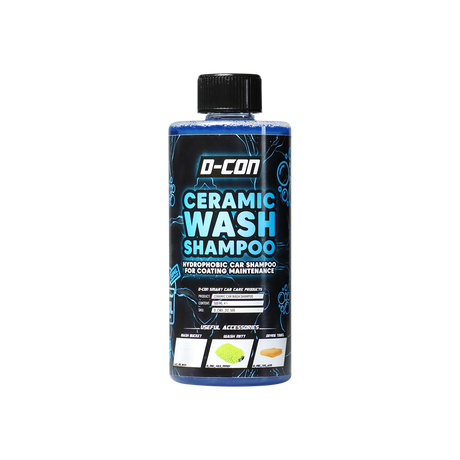
For a clean hand wash you need surprisingly little, but the right little. The foundation is two buckets with a grit guard, a plush wash mitt, a thick drying towel and two cleaners: a foam for the pre-wash and a paint-friendly shampoo for the contact stage.
On the shampoo front, the Autoshampoo As is our standard pick for the weekly wash. At 1:15, one litre covers around eight mid-range cars, which works out to material costs of under a euro per wash. Over 18 verified reviews on Trusted Shops confirm that the yield and the way it protects the finish hold up day-to-day. If you've just sealed your car and want to actively keep that protection topped up, our Autoshampoo selection also has shampoos with an added sealant effect.
If-then logic helps you choose: got a foam lance on the pressure washer? Then the Gentle Snow Foam is your touchless base. Want to keep the sand safely off the paint? The Grit Guard Schmutzsieb is the most important little helper in the 20-litre bucket. And at the finish, the drying towel decides the last few metres to a swirl-free result.
After the wash comes the shine: if you want to protect and refresh freshly cleaned paint between two washes, you'll find the routine for it in our piece on the quick detailer.

Detailing1 insight: Day-to-day from us: the most expensive mistake we keep seeing on test cars in front of our Showroom in Nordhorn is the grit guard that sits in the bucket but never gets used to rub the mitt out. The trick is banal: after each panel, drag the mitt across the grate for five seconds until you see the sand trickle down to the bottom. In June the pollen film joins in, sticky and dust-binding. So never let it dry on, always work on damp paint. Those two seconds of discipline per panel save you half a day with the polisher later on.
No time for the whole post? Get it summarized: