



With a pressure washer for your car it is the litres that count, not the bar
Two machines sit side by side on the shelf. One shouts 160 bar, the other 110. Most people grab the stronger one and then wonder, four weeks later, why the foam stays thin, why rinsing takes forever and why the foam lance only spits soapy water. Search for "pressure washer car" and you mostly get bar figures. The number that actually decides this is printed small on the back.
The cleaning power of a pressure washer is working pressure times flow rate. On a car the flow rate in litres per hour carries more weight than peak pressure, because it flushes the loosened dirt away instead of driving it into the clear coat.
Cleaning power is pressure times flow rate
The cleaning power of a pressure washer is its working pressure in bar multiplied by its flow rate in litres per hour. In cleaning engineering that figure is called a cleaning unit.
The mechanics behind it are simple. The force water lands with depends on its mass and on how fast it changes speed on impact. Jet speed, though, only rises with the square root of pressure. To double impact force through pressure alone you need four times the working pressure. Water volume, by contrast, scales linearly. What that means for you: the second number on the data plate buys you noticeably more cleaning than the first.
On top of that comes the effect that matters on a car. Stripping rust or paint means cutting material away, and that does take extreme pressure. Washing a car means carrying bug splatter, road film and loosened dirt off the panel before any cloth touches the surface. Volume is what does that. Going from 700 to 1200 litres per hour at a steady 100 bar nearly doubles the cleaning power, while pushing pressure up on a small volume barely moves the needle.
Run the numbers on two realistic machines. 110 bar at 600 litres per hour gives you 66,000 cleaning units. 160 bar at 350 litres gives you 56,000. The machine with the smaller headline number rinses clean faster. And the dirt that runs off quickly is dirt that never ends up as a swirl in the clear coat when you move on to the hand wash.
Three classes of machine and what their numbers mean
Hobby machines typically move 330 to 400 litres per hour, the semi-pro class 450 to 600, commercial machines 700 to 1200 litres per hour. Working pressure varies far less than that.
So the question is not which pressure washer gets cars clean fastest, but which one moves enough water. In cleaning units the hobby class sits at roughly 29,700 to 44,000, the semi-pro class at 54,000 to 84,000 and the commercial class at 98,000 to 240,000. The jump from hobby to semi-pro is the biggest one in the whole field, and it costs a lot less than the jump above it. For a single car every week or two, the middle class is the point where foam lays down quickly and rinsing stops being a test of patience.
The second number nobody prints on the box is service life. Entry-level machines almost always run a universal motor, which means carbon brushes. They rub constantly, build heat, spin very fast and often sit above 95 decibels. After roughly 100 to 300 running hours the brushes are gone, and usually the machine with them. For forty minutes of continuous work on a detailing day that is the wrong design.
Above that sits the induction motor. It drives the rotor through a magnetic field with no contact, has no brushes, weighs considerably more thanks to copper and steel, and sheds heat better. It runs below 80 decibels and lasts several thousand hours.
The premium step is the slow-runner at 1400 instead of 2800 revolutions per minute. Because the pump is coupled straight to the motor, that halves the stroke rate of the pistons and with it the wear on seals and valves. Add a brass pump head, ceramic-coated plungers and a genuine oil bath whose first change is due after about 50 running hours. That, not the price tag, is why Kränzle is the reference in the detailing trade.

Safe on paint is 80 to 120 bar
On bodywork, 80 to 120 bar counts as the safe working range, together with a minimum distance of 20 to 30 centimetres to the surface.
What a pressure washer does to car paint comes down to three things: pressure, distance and nozzle angle. A higher pump pressure is fine in itself, as long as nozzle and distance bleed it off.
Go closer than that and local impact pressure climbs steeply. Front bumpers and bonnets are the critical spots, because that is where microscopic stone chips sit. At those edges the jet finds something to grip and works its way into the clear coat. On wraps and paint protection film the rules get stricter: 30 to 50 centimetres of distance, no more than about 140 bar system pressure and a water temperature of 60 degrees at most. Never aim at an exposed film edge at a shallow angle, or the hydraulic force lifts the material and gets under the adhesive.
More vulnerable than the paint are the parts nobody thinks about. Modern wheel bearings carry integrated magnetic encoder rings for ABS and ESP. Their sealing lips deform from close range, the grease washes out, the encoder corrodes and eventually the stability control drops out. Parking sensors in the bumpers and reversing cameras run delicate seals. Door rubbers lose their plasticisers under a direct hit and go brittle. From more than 20 centimetres away, none of that happens.
The nozzle governs all of it. The red 0-degree nozzle and any turbo nozzle are off limits on a car, they cut through tyre sidewalls and rip off trim. The yellow 15-degree nozzle is at best something for wheel arches with plenty of distance. The standard is the green 25-degree nozzle for bodywork, wheels and bug splatter. For rinsing foam off large panels you take the white 40-degree nozzle, which spreads the pressure wide and throws big droplets.
The foam lance fails at the orifice, not the shampoo
A foam lance pulls its concentrate up by suction. If the injector orifice does not match your machine's flow rate, the foam stays watery, whatever shampoo is in the bottle.
The mechanism has no moving parts. Water is forced through a calibrated restriction inside the body, the injector orifice. Flow speed rises there, static pressure drops and a vacuum forms. That vacuum draws the concentrate up out of the bottle through a bypass, mixes it with air and pushes the emulsion through a fine metal mesh, the agitator. That mesh is what turns soapy water into shaving foam.
The orifice decides whether any of this works. Weaker machines below about 400 litres per hour want a 1.1 millimetre orifice, because the tighter restriction accelerates the small volume enough. From 450 to 600 litres you need 1.25 to 1.35 millimetres. Fit the narrow orifice to a strong machine and you build hydraulic back pressure, the pump works against a wall, draws more current and trips the motor protection sooner or later. Most lances ship with 1.25 millimetres, which is exactly the size that generates too little vacuum on a typical DIY machine. If you want dense foam there, you swap the orifice, not the shampoo.
The second classic is false air at the adapter. Quick couplers and brand-specific bayonet fittings need PTFE tape wound anticlockwise. Without it the injector pulls air, the vacuum collapses and the lance throws nothing but suds.
Then there is maintenance. After every wash, take the bottle off and run clear water through the lance for about 30 seconds, or the agitator clogs with soap residue and limescale. That bottles and screw caps are wear parts shows in the reorders that come in for exactly those items.
One last detail gets missed almost every time. A machine at 600 litres per hour empties the bottle faster and dilutes the concentrate more on the paint than one at 350 litres. Dosing belongs matched to your machine, not to the figure on the back of the bottle.

What belongs with the machine and what works without one
The pressure washer dissolves nothing by itself. Chemistry does the pre-wash, the machine puts it on the panel and carries it back off with the dirt.
For the weekly round the Koch-Chemie Gentle Snow Foam "Gsf" 1000 ml / 1 Liter is the calm standard. It works at a pH of around 7.5, so it leaves carnauba wax, polymer and ceramic coatings alone. You dose 20 millilitres into one litre of water in the bottle, and the foam blanket then clings for 4 to 6 minutes on vertical panels instead of sliding straight off. At that dilution one litre covers roughly 50 pre-washes.
13 verified Trusted Shops reviews average five stars for it, and people mention it above all for looking after a ceramic coating. More foams sit in the Snow Foam category, and the full contactless pre-wash routine is in the article Snow Foam for your car.
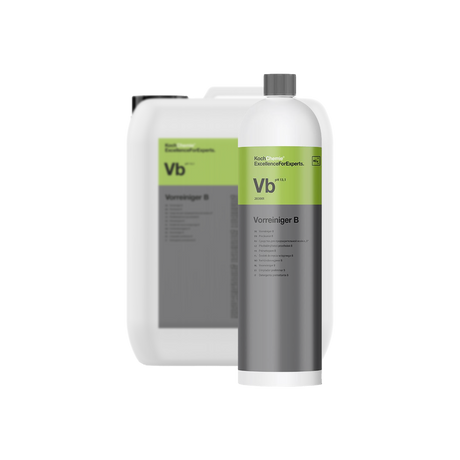
When it gets rougher, alkalinity takes over. The Koch-Chemie Vorreiniger B "Vb" 1000 ml / 1 Liter sits at pH 13.1 and lifts organic deposits and wheel grime in one pass. In the foam lance you dilute 1:30 to 1:50, at a self-service high-pressure bay 1:300 is enough. It is VDA compliant in class A and B, which in practice means 1:300 with up to five minutes of dwell time, or 1:30 with one minute maximum.
The Koch-Chemie Pre-Foam efficient "Pfe" 5 Liter is the bug-splatter version of the same idea, mixed 1:20 and likewise capped at one minute. Both belong on cool, lightly wetted paint. Above 30 degrees surface temperature they dry on, and then you are left with matt streaks that only polishing removes.
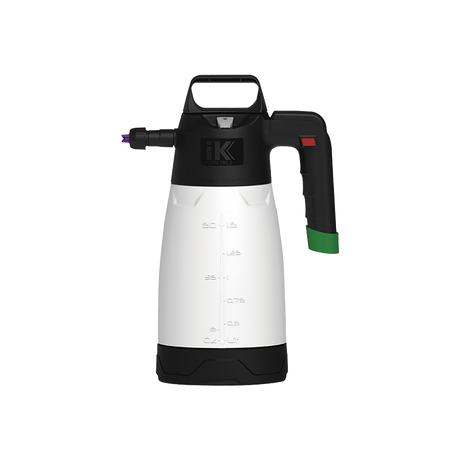
And when the flow rate simply is not there, one route stays open that hardly anyone takes. A pump foam sprayer like the iK Sprayers "iK Foam" Pro 2 1.25 Liter makes its own foam, through a hand pump and a safety valve at 3 bar, with three adjustable foam settings and no tools needed to strip it down. It hangs off no machine and no fitting. On a car's flank it lays down a foam pattern a lance on an underpowered washer never gets close to. The range sits in the foam sprayers category.
The honest limit stays: the pump sprayer does not replace rinsing. You still need water with some pressure behind it to take the foam and the dirt back off, and one fill of a good litre covers one side of the car, not the whole thing. Pump it up four times and you are slower than with a matched lance on a matched machine. The sprayer is the right answer to missing flow rate, not to missing enthusiasm.
If you wash rarely, you need less machine
If you wash one car every week or two, 450 to 600 litres per hour and an induction motor cover you completely. Anything above that buys time, not results.
Which pressure washer gets cars properly clean in your situation comes down to three questions: how often, how many and with what water supply. With that you want a green 25-degree nozzle for the work and a white 40-degree nozzle for rinsing, plus a foam lance with a 1.25 millimetre orifice. If you do several cars a day, the calculation shifts to durability: slow-runner at 1400 revolutions, brass pump, steel-braided hose.
If you work mobile and without a tap, self-priming is the buying criterion. Machines like that draw water from a drum or tank from about 1 to 2.5 metres, but only with a pre-filter. A single grain of sand in the high-pressure pump jams the valves, and pump damage from dirty water is excluded from the warranty by every manufacturer.
If a hobby machine below 400 litres per hour is already sitting in the corner, do not buy a new one, buy the right orifice: a lance with 1.1 millimetres pulls dense foam out of exactly that machine. And if you stand in an underground car park, outside a rented flat or at a wash bay with no power, the pump foam sprayer plus a garden hose is the more honest solution than a machine that never gets used there.
That leaves the point where most machines actually die, and it is neither pressure nor running hours. It is frost. Residual water in the pump chambers and brass valves expands as it freezes and splits the pump block. You only see it in spring, as a puddle under the housing and no pressure build-up.
Preventing it takes a quarter of a minute: close the tap, pull the trigger and let the machine run dry for 10 to 20 seconds until nothing else comes out. At 33 degrees today that sounds absurd, and on Saturday, when the forecast drops to 14 degrees and the calmest wash window of the week opens up, nobody thinks about it either. In November that one move decides whether the machine survives the winter.

Jasper's day-to-day tip: There is a pattern in our own numbers that gets me every time. Over 650 people landed on our pump foam sprayers through search last month, and almost nobody bought one, because the reflex says no pressure washer, no foam. At the same time customers keep reordering spare bottles and screw caps for their foam lance, because the bottle on the machine is wear part number one. Both say the same thing: money goes into the lance and into the chemistry, and the one number everything hangs on gets overlooked. If your foam stays thin, first go and check how many litres per hour your machine actually delivers.
No time for the whole post? Get it summarized: