



Pre-cleaner decides. Before the water runs.
Most scratches in the paint don't happen during washing — they happen before. Exactly when the first wet wash mitt pushes the dry road film across the surface. Sand, fine dust, and dried-on insect residue act like sandpaper between the cloth and the clear coat at this moment. The crucial step happens even before the bucket — and shockingly many skip it because they don't know what's happening.
A pre-cleaner chemically dissolves insects, road film, and brake dust before a microfiber towel or wash mitt touches the surface. Car shampoo cannot do this: It is designed for fresh dirt on an already pre-cleaned surface, not for dried-on proteins at pH 7. Those who understand this difference wash their car differently — and with significantly fewer contact marks.
Without pre-wash, every touch is a risk
Every contact between a cloth and an unrinsed surface transfers particles across the paint — this is not theory, but physics. Dirt that has not been chemically dissolved must be mechanically lifted. When lifted, it grinds. Fine sand particles from the road, pollen residue, and dried insect remains have a hardness of 6 to 7 on the Mohs scale. Clear coat is at 2 to 3. The math is clear.
The clear coat of modern vehicles is 40 to 60 micrometers thick. Once visible holograms or wash marks require machine polishing — a one-to-three-step machine polishing process depending on the depth of the scratches. Those who regularly wash without pre-washing measurably shorten the interval to the next polish. A pre-cleaner is not a luxury and not a waste of time — it is pure damage prevention and, in the long run, the most cost-effective decision in vehicle care.
Particularly critical: insect residues. Chitin proteins harden on the paint within 24 hours and chemically bond with the clear coat surface. What can be softened with lukewarm water after an hour requires an alkaline pre-cleaner with several minutes of dwell time after 48 hours. What is still on the paint after a week attacks it — the altered pH in the protein stain acts like a localized acid on the paint surface. The clock starts as soon as insects land.
The same applies to bird droppings. Bird droppings contain uric acid and intestinal bacteria. Uric acid corrodes visible marks into the clear coat within a few hours when hot — sun, warm hood. Mechanically removing dry bird droppings is one of the most common mistakes: It causes scratches that are immediately visible in back light. First soak, then dissolve with pre-cleaner, then rinse. Never wipe dry.
Detailing1-Insight: Two short passes instead of one long one — that's the most effective principle for pre-washing. The first pass loosens and softens coarse dirt. Rinse briefly. The second pass then removes what the first one dissolved. A single long dwell time achieves less than two short passes with rinsing in between. The active ingredient is saturated after 5 to 6 minutes — further waiting no longer dissolves dirt, but increases the risk of drying. This applies particularly to dried-on insect infestation and salt film after winter.
What pre-cleaners do chemically — and why shampoo can't
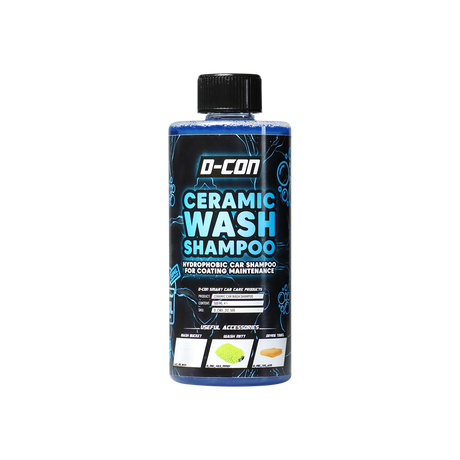
Car shampoo is set to pH 6 to 8 — coating-friendly, highly foaming, with moderately aggressive surfactants that dissolve fresh dirt and wax residues. It cleans through surfactant action combined with mechanical removal by wash mitt or mop type. What it doesn't dissolve: dried-on proteins like insects and bird droppings, oil-water emulsions from road film, and oil-based residues in wheel arches.
Pre-cleaners work alcaline, with pH values between 11 and 13. Alkaline chemistry saponifies fats (ester hydrolysis), denatures proteins (breaking peptide bonds) and dissolves organic compounds without mechanical friction. The dirt is chemically detached from the surface, then rinsed off. This is touchless cleaning — no cloth, no sponge, no abrasion on the clear coat surface.
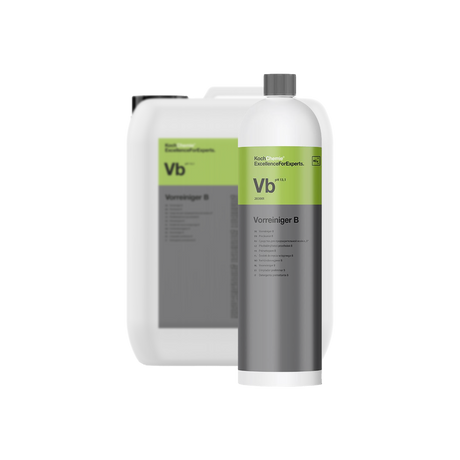
The Koch-Chemie Pre-Cleaner B "Vb" is at pH 13.1 and contains corrosion inhibitors for anodized aluminum — this protects aluminum rims, aluminum frames, and engine components from the attack of strong alkalis. VDA-compliant class A and B means: independently tested for vehicle paints and surfaces according to German automotive standards. Rapidly separating according to ÖNORM 5106 means: The cleaner separates cleanly from the paint after rinsing, without residues that interfere with later coatings or waxes.
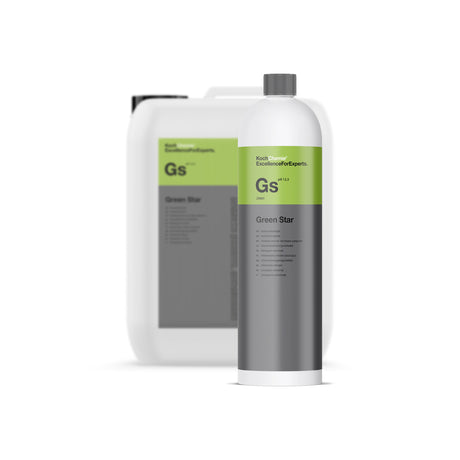
The Green Star "Gs" comes in at pH 12.5 to 13 and is universally applicable due to its dosability. 1:5 for heavily oiled workshop floors, 1:10 for engine compartments and lifts, 1:20 for exterior plastics and insect removal on the vehicle front, 1:50 for mild maintenance cleaning without chemical stress on the surface. One concentrate, seven areas of application — that makes the Green Star the primary recommendation for anyone who wants to work flexibly.

Foam lance, high pressure or spray bottle — which method for whom
The foam lance is the safest application method for private users: It distributes the pre-cleaner evenly, creates an adhesive foam gel that does not immediately run off vertical surfaces, and gives the active ingredient time to work. The dwell time — 3 to 5 minutes for fresh dirt, 5 to 8 minutes for dried-on insects — can only be achieved if the product stays on the surface instead of running off immediately.
With the Pre-Cleaner B, a foam lance is used at 1:30 to 1:50. One liter of concentrate yields 30 to 50 liters of ready-to-use solution. For a car, this is enough for five to eight complete pre-washes. The concentrate is phosphate-free and rapidly biodegradable according to OECD 301 — relevant for anyone washing in driveways or near gardens.
Self-service car washes (self-service high-pressure systems) require stronger dilution: 1:300 for Pre-Cleaner B in the high-pressure tank. This sounds like a little, but high-pressure systems with 100 to 180 bar achieve through pump pressure what the foam lance achieves with dwell time. If you wash at a self-service car wash, you should use the pre-wash nozzle and plan for two passes.
Those without a foam lance can use Pre-Foam efficient "Pfe": a ready-to-use foam pre-cleaner with a citrus scent, directly applicable from the spray bottle. No mixing, no calibration, no dosing errors. Dissolves insects and road film, suitable as a pre-treatment for individual areas such as the front, sills and wheel arches — before the vehicle is treated over a large area with Pre-Cleaner B.
When shampoo is enough — and when it isn't
There are situations where a pre-cleaner is pure time expenditure with no significant added value. And there are situations where it makes the difference between scratch-free paint and permanent wash marks. The decision depends on the type of dirt, the dwell time of the dirt, and the surface condition.
| Type of Dirt | Pre-cleaner needed? | Recommendation |
|---|---|---|
| Fresh dust (under 2 days) | No | Rinse thoroughly, then shampoo |
| Light road film (2–5 days) | Recommended | Short dwell time, Pre-cleaner B 1:40 |
| Dried insects (over 24h) | Yes, mandatory | Pre-cleaner B or Green Star 1:20 on front, 5 min dwell time |
| Bird droppings | Yes | Soak, then pre-cleaner — never wipe dry |
| Salt film after winter | Yes | Pre-cleaner B double pass, include underbody |
| Ceramic-coated vehicle | Yes, always | Pre-clean before shampoo, rinse completely |
| Freshly waxed vehicle (under 1 week) | No | Mild shampoo is enough, wax layer protects |
Anyone working with a coated vehicle — ceramic sealant or SiO2 sealant — should always apply the pre-cleaner in the correct dilution and rinse it off completely before using the wash mitt. Coatings are sensitive to pre-cleaner residues that have not been completely rinsed out from under the shampoo foam. This is especially true at high temperatures in summer.
The rule of thumb: Any contamination that cannot be wiped off with a finger without rubbing before washing requires a pre-cleaner. Everything else can be handled by shampoo. If you're unsure, you can't go wrong with pre-cleaning as a rule — it takes five minutes and protects the paint.
For ceramic sealants, the rule is clear: alkaline pre-cleaners with subsequent complete rinsing do not endanger the coating — they help to free the pores of the sealant from contaminants that shampoo does not dissolve. What stresses a coating are pre-cleaners that dry and are not completely rinsed. More on shampoo selection after pre-washing can be found in the article Choosing the right car shampoo.

The most common mistakes when pre-cleaning
Pre-cleaner on hot or sun-warmed paint is the most common mistake. Highly alkaline products with pH 13 dry on surfaces above 30 °C in seconds. The active ingredient crystallizes, leaves white streaks and can leave hard-to-remove stains on sensitive paints. Thermometer test: If the surface feels hot, it is too hot. In case of doubt, cool briefly with clear, cold water and park in the shade.
Higher concentration does not mean better cleaning. Pre-cleaner B at 1:15 instead of 1:30 will damage rubber seals, certain soft plastics, and unsealed aluminum with longer dwell times. The indicated dilutions are practical values from the workshop. The active ingredient is fully active at the recommended concentration — more does not increase efficacy but does increase the risk of material damage.
Spraying dry onto a dust-covered surface: If the coarse dirt has not first been rinsed with clear water, the pre-cleaner mixes with the dirt instead of dissolving it. The result is a dirt-cleaner mixture that is harder to remove than both components individually. Correct procedure: rinse cold, spray on pre-cleaner, let it work, rinse thoroughly.
Applying to fresh care products: Spraying a pre-cleaner on freshly applied quick detailer or sealant residue neutralizes the care film. Alkaline chemistry saponifies waxes and SiO2 residues. Sequence is unavoidable: pre-cleaner first, then shampoo, then care product. Those who reverse this sequence repeat the work.
Three products, three scenarios: the Detailing1 assortment
Three pre-cleaners in the assortment, three clearly defined areas of application — no overlap, no confusion. This significantly simplifies the purchasing decision and prevents you from choosing a product that is not optimized for your specific use case.
The Koch-Chemie Pre-Cleaner B "Vb" is the tool for systematic vehicle care with high-pressure technology. pH 13.1, VDA-compliant class A and B, phosphate-free, corrosion inhibitors for aluminum. Designed for foam lance (1:30 to 1:50) and self-service high-pressure (1:300). Available in three container sizes starting from €5.75 — the smallest is sufficient for several complete pre-washes at 1:40. Those who regularly maintain their vehicle and use a foam lance will find the strongest product in the range here.
The Koch-Chemie Green Star "Gs" is the multi-purpose concentrate for anyone who wants to use one product for various tasks. pH 12.5 to 13, dosable between 1:5 (heavy workshop contamination) and 1:50 (gentle maintenance cleaning). Just as effective on the vehicle front at 1:20 as in the engine bay at 1:10. Users from our shop consistently report its reliability on stubborn spring insects. 12 verified reviews, 4.5 out of 5 stars. Available from €6.08 in three container sizes.
The Pre-Foam efficient "Pfe" is for anyone who doesn't want to mix: a ready-to-use foam pre-cleaner with a citrus scent, directly usable from the spray container. No calibration, no dosing errors, no foam lance accessories needed. Dissolves insects and road film, suitable as a pre-treatment for individual areas such as the front, sills and wheel arches. For occasional washes, it is the pragmatic choice.
Anyone who doesn't use one of these three pre-cleaners and washes directly with shampoo risks more contact damage than necessary. The decision pays off at the latest when the first scratch becomes visible in backlight. Then it's time for polishing, not the pre-cleaner. Those who start early save themselves polishing — and keep the clear coat in optimal condition longer.
Regarding which shampoo fits afterwards: A pH-neutral, coating-compatible car shampoo safely completes the washing process. If you are not yet sure which shampoo suits your vehicle and care system, the article Choosing the right car shampoo: pH value, coating compatibility, and dosage provides a structured decision basis — from coating-safe concentrate to high-gloss shampoo, sorted by application.
Pre-cleaners are not an extra step for perfectionists. They are the only step that prevents dirt from being dragged across the paint during washing. Once you've seen the difference — paint before and after regular pre-washing under spot light — you'll wash differently. Not because you have to, but because you understand what happens without pre-washing. Good car care always begins with the step before the actual wash.

No time for the whole post? Get it summarized: