Car leather cleaner: mild or strong, and the dirt decides
Jasper von Detailing1 |



SONAX
PROFILINE LeatherCareFoam Leather Care (Foam)
LeatherCareFoam — Conditioning foam for supple smooth leather

Built-up oils come off, worn grain does not. A test patch shows which.

SONAX
XTREME LederPflegeSchaum Leather Care
LederPflegeSchaum — silikonfrei, Carnaubawachs, Reinigung & Pflege
D-CON
Pure-Leather-Conditioner Leather Care
Premium leather care with UV protection


Koch-Chemie × COLOURLOCK
COLOURLOCK "Classic Car Leather Care" Set (care set for tired classic-car leather)
Vintage car leather becomes soft, supple, and durably protected again

Meguiars
GOLD CLASS Leather Conditioner Leather Care
Leather care for a perfect finish


Meguiars
GOLD CLASS Rich Leather Gel Leather Care

Koch-Chemie × COLOURLOCK
COLOURLOCK "Complete Leather Repair Kit"
Complete Leather Repair Kit with Liquid Leather and Dye
Koch-Chemie × COLOURLOCK
COLOURLOCK "Leather Fresh C & P Set"
Cleaning, color refreshment and UV protection for smooth leather


Koch-Chemie × COLOURLOCK
COLOURLOCK "Viscose cloth" Viskosetuch zum Auftragen
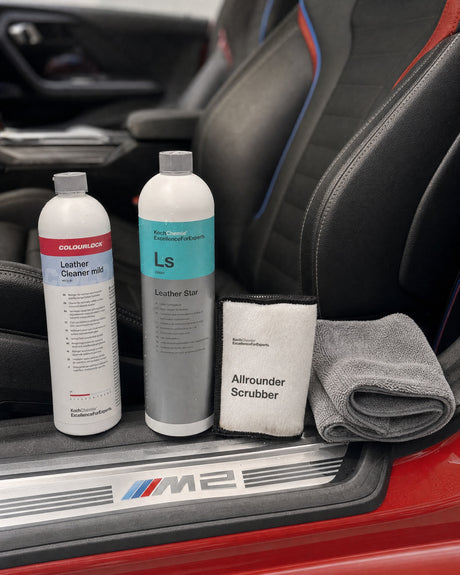
Conditioner lasts longer on clean leather, otherwise you seal in dirt
Dr. Wack "A1"
A1 "Leder-Set" Leather Care Set
Reiniger und Pflege für Glattleder, je 250 ml plus Tuch


Dr. Wack "A1"
A1 "Leather Care" Leather care
Jojobaöl-Pflege für Glattleder und Kunstleder, mit UV-Schutz
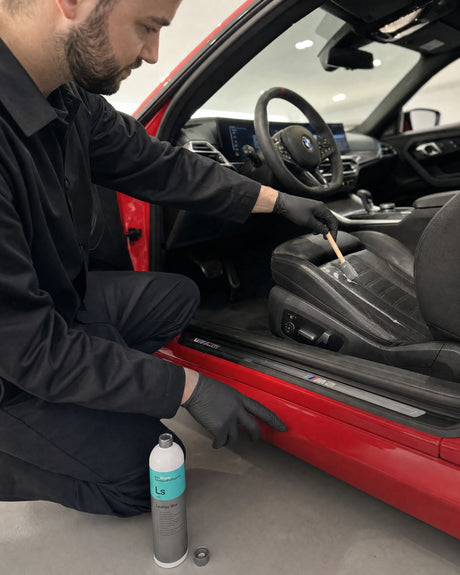
Our guide covers cleaning, care and common mistakes.
What does leather care actually do in a car? It puts back the plasticisers that evaporate out of the pigmented top-coat on your seat leather. With nothing to top them up, that layer goes hard and cracks exactly where the seat flexes — on the cushion and the driver’s bolster. At Detailing1 you’ve got 51 care products to choose from, including 17 matched sets from COLOURLOCK, Koch-Chemie, SONAX and Meguiar's.
Leather care is the second step after cleaning, and it works on the finish, not the hide underneath. That top-coat of pigment, binder and plasticisers is what gives the leather its colour and its resistance to wear. Over the years its plasticisers migrate to the surface and flash off, and heat and sun through the glass speed that up. Care feeds oils and fats back into the mix and keeps it bending instead of snapping.
Detailing1's tip from the shop: We get a lot of questions about seats that feel tacky after care. The cause is nearly always the same: too much product and no dwell time. Leather only takes up so much oil; the rest sits on top as a film and grabs dust. So lay the care on wafer-thin with an applicator, work it in with circular passes and give it twenty minutes to do its job. Then lift the excess with a dry microfibre cloth. Don’t sit back down until nothing rubs off — otherwise the care ends up on your trousers instead of in the leather.
Leather care sounds like cosmetics but it’s really materials science. What happens inside the seat comes down to three steps.
The finish is a composite of pigment and binder, kept soft by plasticisers. Those molecules sit between the polymer chains and act like ball bearings — they let the chains slide past each other instead of breaking. In practice that means the seat gives when you sit down instead of cracking.
Plasticisers are volatile. They diffuse slowly to the surface and flash off there, and heat speeds the whole thing up massively. A car parked in the summer sun tops 60 degrees inside — more happens there in a week than over a whole winter.
A leather care brings oils and fats with it, plus emulsifiers that are what let them travel into the finish in the first place. Without an emulsifier the oil would just sit on top and shine. What that means for you: whatever you can’t see anymore after working it in has gone to the right place. Whatever shines on top needs wiping off.
Worth knowing, because people usually expect otherwise: that new-leather smell doesn’t come from the leather, it comes from exactly these volatile bits of the finish gassing off. It fading after a few years isn’t a drop in quality, it’s simply the end of that outgassing. Products that promise to bring the smell back are working with fragrance, not with the material.
The second job is protection from above. The care film makes it harder for skin oils and denim dye to work their way into the finish. On light leather that’s the real reason to keep on top of care — not the suppleness, but the barrier against dye transfer.
The format matters less for how well it works than for how easy it is to handle — and with leather, handling is the hard part.
Liquid emulsions are the classic format. They soak in nicely and spread evenly across flat areas like the seat cushion. Their downside shows up at edges and seams, where they run off and pool. The Leather Star „Ls" belongs in this group.
Creams and gels stay put where you lay them down. That makes them the better call for vertical faces like bolsters, door cards and backrests. The Meguiars Gold Class Rich Leather Gel is one of this type, as is the Meguiars Gold Class Leather Conditioner.
Foams are the easiest to dose and the safest route for beginners. The foam shows you where product already is, and it’s hard to overdo. The SONAX XTREME Leather Care Foam and the SONAX PROFILINE Leather Care Foam cover this format.
When you pick a format, take a look at the seat shape. Heavily contoured sports seats with pronounced bolsters and lots of seams are easier to work with a cream or foam, because nothing runs into the recesses. Flat benches and smooth rear seats go quicker with an emulsion, since you can knock out big areas in one pass.
Detailers are the fourth group and they’re meant for the in-between round. They carry little active ingredient and are there to freshen things up between two proper sessions. The Meguiars Ultimate Leather Detailer lives here and is no substitute for feeding the leather.
The range holds two fundamentally different approaches side by side, and both earn their place.
Classic care feeds the leather. It soaks in, works inside the material and washes out again over the months. The upside is the material care itself — the finish stays elastic. The downside is having to repeat it, because the effect tails off.
A leather sealant takes the other road. It lays a lasting protective layer on the surface that keeps dirt and dye transfer off, without travelling into the material itself. The GYEON Q² LeatherCoat (REDEFINED) ceramic leather coating stands for this type, as does the SONAX PROFILINE LeatherProtection.
The honest take: a sealant protects better against denim dye and stains, but it doesn’t replace feeding. Seal only, and you’ve got a clean seat over a finish that’s still drying out. The smart move is to combine the two — feed it, let it dry, then seal.
For light leather in a family car, a sealant is the investment that pays for itself fastest. For dark leather in a car without kids, classic care is usually plenty.
One thing that counts when you seal: the layer only lasts as long as it isn’t rubbed off. On the seat cushion, where every trip means friction, it’s gone far sooner than on the backrest. So don’t expect it to wear out evenly — expect it to fade from the middle out, and plan your top-up by the state of the cushion, not by the calendar.
The routine has four steps, and three of them get skipped on a regular basis.
Cleaning comes before care. Care on unclean leather traps skin oils and grime under the film — the result is a greasy surface that soils again faster than before. You’ll find the right products under Leather cleaners.
After cleaning, the leather has to dry all the way through. Leftover moisture pushes the oils out and leads to uneven uptake, which shows as lighter and darker patches once it dries. Half an hour at room temperature is usually enough; keep hot air and direct sun off it, since both drive out more plasticiser.
Then it goes on thin and gets worked in. Applicator rather than cloth, circular passes, section by section. On perforated, ventilated seats you go especially sparingly — product that runs into the holes doesn’t come back out and collects dust.
Twenty minutes of dwell time, then lift the excess with a dry microfibre cloth. This last step is the difference between a matt, supple seat and a sticky one. It costs five minutes and it’s still the one most often left out.
Seams get their own pass. Product gathers there and lightens the thread over time. Run a dry brush along the seam and pick up whatever has pooled. On light contrast stitching over dark leather that’s not a cosmetic detail — it’s the difference between clean and blotchy.
Our care range breaks down by how demanding the job is and by leather type.
For everyday pigmented factory leather, the standard care products cover it. The THE FINISHER „LeatherLock" leather care gives stronger protection than plain feeding, while the D-CON Pure-Leather-Conditioner is the version with no silicone and no fragrance.
COLOURLOCK is the biggest block by far and comes out of professional leather repair. The sets are graded by the age of the leather, which is unusual in this category: the COLOURLOCK „New Leather Care" Set (care set for new smooth leather) is aimed at cars up to about three years old, the COLOURLOCK „Smooth Leather Care" Set (care set for smooth leather) at older ones.
For classic cars and heavily worn leather there’s the COLOURLOCK „Classic Car Leather Care" Set (care set for worn classic-car leather). It carries more feeding oil, because old leather takes up far more than new and is downright thirsty on the first pass.
SONAX and Meguiar's cover the middle segment and are strong where easy application matters — foams, gels and detailers that come out even without any practice. GYEON and D-CON take the ends: one with the ceramic sealant for maximum service life, the other with the pared-back formula, no silicone and no fragrance, for anyone who specifically doesn’t want that in the cabin.
Prices run from under ten euros for a single bottle up into three figures for the repair sets. For a car with well-kept factory leather the sensible range is at the low end: a 500 ml bottle lasts several years at two applications a year.
The age of the leather decides how much care makes sense — and from what point it stops doing anything at all.
On a new car the finish is still full of plasticisers and takes up correspondingly little. Here it’s about holding the line, not topping up. A thin application twice a year is enough, and on light leather a sealant from day one is worth it, before the first denim dye settles in.
On an everyday car of five to ten years the payoff is biggest. The finish has measurably lost plasticiser but is still intact — exactly the state where feeding works. Twice a year, with the focus on the driver’s seat and the driver’s bolster, because that’s where the movement happens.
On a classic or any car with visibly dry leather the rule is: several thin applications a few days apart beat one thick one. Dry leather drinks it in, and whatever it can’t take in one pass sits on top. Three passes over a week get more into the finish than one saturation on a single afternoon.
On a lease return, do the sober maths. Just before handover, care improves the look but no longer improves the protection retroactively. If the car goes back in two months, a thorough clean with a light care over the top is enough. If you’re keeping it, start the regular rhythm straight away.
Once the finish has actually cracked, care stops working. It makes the surface look better for a few weeks and closes no crack. From that point on you’re into leather repair with colour, and that’s what the COLOURLOCK repair sets are for.
If cleaning comes first, you’ll find it under Leather cleaners. Both steps together with working out the type are laid out in the overview under Leather, and for cloth seats the road leads to Fabric & upholstery.
Too much choice in Leather care? Get help picking:
Jasper von Detailing1 |

Daniel von Detailing1 |

Daniel von Detailing1 |

Daniel von Detailing1 |

Daniel von Detailing1 |

Daniel von Detailing1 |

Daniel von Detailing1 |

Daniel von Detailing1 |

Daniel von Detailing1 |

Daniel von Detailing1 |

Daniel von Detailing1 |

Jasper von Detailing1 |