

Removing dried-on tree sap from car paint: dissolve first, then seal
Daniel von Detailing1 |


ZviZZer
All-in-one polish with sealant for cut, gloss and protection
ZviZZer
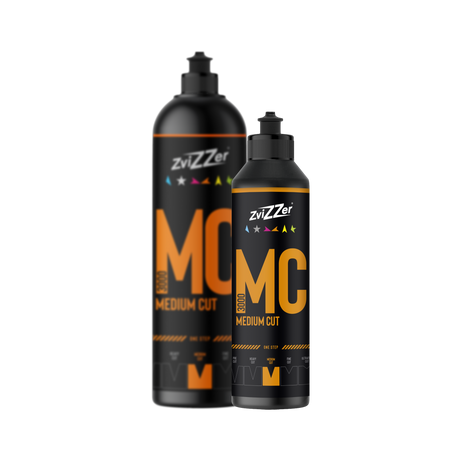
MC 3000 "Medium Cut" One-Step Polish (Orange)
Medium-cut one-step polish for correction and gloss
ZviZZer
HC 4000 "Heavy Cut" Cutting Compound (Red)
Strong cutting compound for deep scratches and oxidation
ZviZZer
FC 2000 "Fine Cut" finishing polish (Yellow)
Anti-hologram finishing polish for hologram-free high gloss
ZviZZer
UC 1000 "Ultrafine Cut" finishing polish (Green)
Ultra-fine finishing polish with sealant for deep gloss
ZviZZer
PC 5000 "Pre Cut" Cutting Polish (Blue)
Heavy cutting compound from P1500 for deep scratches and removal
ZviZZer polishes are a colour-coded cut-level system from Pre Cut to Ultrafine Cut, plus the colourless One Polish. Six polishes, each for a different scratch depth, all water-based and Made in Germany. You choose the level by the defect, not by feel.
Polishes by ZviZZer are cutting and finishing polishes that get their cut from a graded aluminium oxide abrasive and are sorted by colour according to level. The logic is a cut system: Pre Cut (blue) removes the most, Ultrafine Cut (green) the least, with Heavy, Medium and Fine in between. Deeper scratches need a coarser level, finished paint the finest. Picking the right cut is the whole art here.
Detailing1's tip from the shop: The most common mistake is starting with the coarsest polish because it works fastest. We do it the other way round: try the mildest level on a test section first, and only go one step coarser if the defect stays. That way you only remove as much clear coat as necessary. Clear coat is often only around 40 to 50 microns thick, and every cutting step costs some of it that never comes back.
With ZviZZer, the colour tells you straight away how aggressive a polish is, from the blue Pre Cut to the green Ultrafine. Once you know the order, you don't need to study the label any more.
The chain runs from coarse to fine: Pre Cut (blue) is the most aggressive level, followed by Heavy Cut (red), Medium Cut (orange), Fine Cut (yellow) and Ultrafine Cut (green) as the finest. These five colours aren't decoration; they're a scale. The closer a polish sits to blue, the more material it takes off and the more refining it needs afterwards. The closer it is to green, the gentler it works and the nearer you already are to the finished gloss.
The clever bit: the same principle shows up again on the pads, where the same colour stands for pad hardness. Blue is the hardest level on pads too, green the softest. Polish and pad speak the same colour language, which makes matching them in your head easy. You only need to remember one order and can apply it to both.
In practice, that saves time and wrong picks. Instead of comparing five data sheets, you think along a single axis from coarse to fine. Especially when several cars are lined up and the clock's ticking, being able to grab the right colour fast is worth its weight in gold. You'll find the full system overview, with machine choice and how polish, pad and cleaner fit together, on the parent page Polishing by ZviZZer.
Six polishes, six clearly separate jobs, from deep scratches to the last per cent of high gloss. Here's the line-up so you can place each level.
PC 5000 "Pre Cut" in blue is the most aggressive level and removes deep scratches and sanding marks from P1500. It uses a mixed aluminium oxide with a high abrasive content, deliberately leaves a working haze and preps the panel for the next level. HC 4000 "Heavy Cut" in red is the second-highest level, tackles deep scratches and oxidation from P2000 and works with a very uniform abrasive that cuts rather than scratches. Both are cutting compounds for restoring weathered paint, not products for a quick refresh in between. PC 5000 is the choice when even two passes of Heavy Cut won't close the scratch, and it preps the panel specifically for the red level.
MC 3000 "Medium Cut" in orange is the versatile middle ground: a one-step polish that corrects fine scratches and swirls from P3000 and builds hologram-free gloss in one pass. It's a good starting point on lots of paints because it corrects and shines at the same time. Next comes FC 2000 Fine Cut in yellow, a finishing polish for holograms and fine swirls after a cutting step, aiming for a one hundred per cent hologram-free surface.
The scale ends with UC 1000 Ultrafine Cut in green, the finest level, with an integrated ceramic emulsion that, according to the manufacturer, also seals the paint for months. It takes out the finest micro-marring and brings a deep wet-look gloss plus protection in one step. Outside the colour scale sits One Polish, a colourless 3-in-1 polish with cut, gloss and temporary protection from P2000, whose aggressiveness is set purely by the pad. It's the practical all-rounder for mixed everyday defects when you don't want a separate bottle on the shelf for every grade.
The six polishes split into three roles, and those roles decide whether you'll need to refine afterwards or not. Know the difference and you'll plan your process properly.
Pre Cut and Heavy Cut are pure cutting compounds. They take a lot out but deliberately leave a slight haze or holograms, because they work without fillers and hide nothing. After both, refining is a must, or the paint stays dull rather than clear. That's their honest limit: they aren't a final polish and should never be the last step. Stop here and you'll see every bit of haze in the sunlight.
Fine Cut and Ultrafine Cut are the opposite. They hardly cut at all and refine instead, taking out holograms and building deep gloss. Their correcting power is low, but their finish is flawless. Used alone on badly weathered or dull paint, they'd be out of their depth, because they're meant as a final step, not as heavy lifters.
The one-step polishes MC 3000 and One Polish sit in the middle and try to do both in one pass: correction and gloss. That works well on light to moderate defects and saves a whole stage. On badly weathered paint, though, it doesn't replace a two-step approach. In our experience, a one-step polish is the most honest compromise between effort and result for everyday paint, while concours standards call for the multi-step route.
You find the right cut level on the car itself, not at a desk, and the fingernail test is your best indicator. If your nail catches in the scratch, the defect is deep.
The rule of thumb: if your nail clearly catches, you need Pre Cut or Heavy Cut. If it's just fine swirls and holograms, Medium Cut as a one-step or going straight to a finishing polish will do. We always test on a small section first with the mildest level and only go one step coarser if the defect stays. That keeps as much clear coat as possible and avoids the most expensive mistake in polishing: taking off too much.
To apply, first spread the polish at around 1,000 rpm and then work it in. The cutting compounds go up to about 1,800 rpm with medium pressure; the finishing polishes stay gentler at around 1,600. Keep the panel moist and don't let the polish run dry, or it'll dust and clog the pad. A small, pea-sized amount is enough for a palm-sized section.
One last quirk: after UC 1000, don't wipe the paint down with isopropyl alcohol, or you'll take the fresh sealant layer straight off again. That's the most common sequencing mistake with this polish. Which pad hardness and size to use with which polish is a subject of its own, because the pad also steers the effective cut. We go into that on the Polishing Pads by ZviZZer page.
Lots of manufacturers make polishes, but few make the cut level so consistently readable from the colour. That's ZviZZer's practical advantage in day-to-day use.
Other lines often work with numbers or made-up names where you first have to look up which polish is coarser. The ZviZZer system removes that hurdle, because colour equals level and the same colour comes back on the matching pad. Then there's the self-diminishing abrasive, which delivers a hologram-free finish on the finer levels without you necessarily having to follow up with a second polish. That's a real plus for beginners in particular, because less can go wrong.
A second difference lies in the system's reach. With five grades plus the colourless One Polish, you cover everything from deep cutting correction to a pure concours finish with a single brand. You don't have to pair a polish from manufacturer A with a pad from manufacturer B and hope the characteristics match. Everything is matched, and the colour logic runs right through.
Honestly placed, ZviZZer sits between pure hobby chemistry and uncompromising pro kit. The polishes are water-based, free from silicone and solvents and made in Germany, which points to consistent quality. If you want a coherent, matched system from one source instead of mixing products from different brands, you'll find a logic here that hangs together. If, on the other hand, you only want to get rid of one defect once, a good one-step solution gets you there faster than a whole set.
In the end, only one question counts: how deep is the defect and how much effort do you want to put in? The whole buying decision hangs on that.
For badly weathered paint with deep scratches, start with PC 5000 or HC 4000, then refine with MC 3000 and a finishing level. For typical everyday paint with swirls and fine wash marring, MC 3000 as a one-step is the practical default, because it corrects and shines in one pass. If you want a single flexible product for changing defect depths, one that also adds temporary protection and lets the pad set the grade, go for One Polish.
If you're after the last per cent on paint that's already well looked after, FC 2000 and UC 1000 are the right choice, with UC 1000 bringing protection along thanks to its integrated sealant. On very soft or dark paints that show every bit of micro-marring, the extra Ultrafine step is especially worth it. Starting one level milder is almost always the smarter call there.
In our experience, a combination of one cutting level and one finishing level covers most cases; a full five-level set mainly pays off for frequent and very varied correction work. Beginners are safest with MC 3000 or One Polish, because both are hard to overdo and give you a result you can show off in one pass. All six polishes come in 250 and 750 millilitres, so you can grab a small bottle to try first and stock up later once the level has proved itself. If you'd like to understand the whole workflow from cut to finish first, start at Polishing by ZviZZer and work your way to the right level from there.
Too much choice in Polishes by ZviZZer? Get help picking:
Add Detailing1 as a preferred source on Google
Daniel von Detailing1 |

Daniel von Detailing1 |

Daniel von Detailing1 |

Daniel von Detailing1 |

Daniel von Detailing1 |

Daniel von Detailing1 |

Jasper von Detailing1 |

Daniel von Detailing1 |

Daniel von Detailing1 |

Jasper von Detailing1 |

Daniel von Detailing1 |

Daniel von Detailing1 |