



Gently Remove Pollen and Sahara Dust from Paintwork in May
In May, a special mixture settles on car paint: fine pollen grains that become sticky with the first sun, along with Sahara dust from the south and remnants of grit left over from winter. If you start scrubbing with a wash mitt at this stage, you're just dragging these particles across the clear coat, creating the very fine scratches that later appear as swirl marks in the sunlight. The trick is not more pressure, but less contact. This is where pH-neutral Snow Foam comes in.
Koch-Chemie Gentle Snow Foam creates a thick foam blanket that loosens dirt before hand contact. With a pH of 7.5, it does not attack wax or ceramic coatings, and one liter of concentrate is sufficient for approximately 50 pre-washes.
What makes Gentle Snow Foam a pH-neutral pre-wash
Koch-Chemie Gentle Snow Foam is a pH-neutral cleaning foam with a working pH of around 7.5. It is applied to dry paintwork with a foam lance or pump sprayer, where it loosens pollen, road dust, and insect residues before the wash mitt touches the paintwork.
The chemistry behind it is not spectacular, but precise. A combination of anionic and non-ionic surfactants envelops each dirt particle with a hydrophilic layer. The fat-loving end of the surfactant binds to organic contaminants, while the water-soluble end points outwards. As soon as you rinse with clear water, the surfactant and the bound dirt rinse away. Cocamidopropyl betaine acts as a foam booster, ensuring that the foam doesn't immediately drip, but adheres as a creamy blanket to vertical surfaces.
The crucial point is the pH value of 7.5. This number is not marketing, but measurable chemistry. Wax and sealant layers are based on polymers or quartz-like SiO structures. Alkaline cleaners with a pH of 11 or higher measurably hydrolyze these compounds—the durability of your sealant decreases with each wash. This doesn't happen at pH 7.5. A GYEON Q² Mohs coating or a carnauba wax remains as intact after Gsf as before.
The Gsf stands in a class of its own for weekly care for a simple reason: you can use it every weekend without weakening the expensive sealant. Active alkaline foams are more powerful, but they are the wrong choice for regular care on a sealed car.
Foam Lance and 20 Milliliters per Liter as a Clean Working Measure
The standard dilution for a foam lance is 1:50. This means 20 milliliters of concentrate per liter of water. At this ratio, a creamy foam blanket forms, adhering to vertical surfaces like doors, fenders, and the tailgate for four to six minutes.
Always apply Gentle Snow Foam to dry paintwork. This is the most common misconception: if you wet the car beforehand with a pressure washer, you rinse off the surfactants before they can work. The foam adheres best to a dusty, slightly grippy surface — that's exactly what the surfactants are formulated for. Start at the top of the roof, systematically work your way down to the sills, and let the foam sit for four to six minutes. During this time, pollen grains, loose sand, and bird dropping residues will detach from the clear coat. Then rinse with a pressure washer, using a soft spray, from top to bottom.
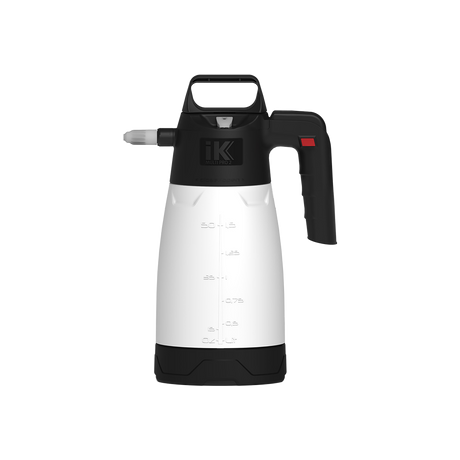
One liter of concentrate, at 20 ml per liter of water, is sufficient for approximately 50 pre-washes — making Gsf one of the most economical foams in its class. In a pump sprayer like the iK Multi Pro 2, 1:50 is also sufficient, though the foam is slightly softer than with a lance. If you use the foam as a hand wash shampoo: 50 ml to 10 liters of water in a bucket, then the cleaning is done in one go.
At temperatures below ten degrees, the foam structure visibly deteriorates. The surfactants work less effectively in colder temperatures, and the foam becomes thinner. If you're out in cool 9-degree weather in May, increase the dosage to 25 milliliters per liter and let the foam sit for six minutes instead of four. This will ensure the blanket stays on the door.
What is often underestimated regarding durability: the foam must not dry out. This is rarely a problem on a cool, cloudy May day, but it is on a sunny spring day with direct midday sun. As soon as the foam starts to become dull in the glossy areas, the surfactants have broken down at the top and can no longer dissolve anything. Rule of thumb in summer: it's better to work in two stages — first foam one side of the vehicle and rinse after four minutes, then the other. This keeps the foam active the entire time.

Pollen, Sahara Dust, and Loose Particles are its Home Turf
Gentle Snow Foam is designed for weekly maintenance, not for restoration. Its strength lies in the three most common types of contamination that settle on paintwork in May: pollen, fine road dust, and Sahara dust.
Pollen are organic particles with a sticky outer layer. As soon as they land on warm paintwork and the sun shines on them, their enzymes begin to attack the clear coat layer. In practice, this means that if pollen is left on dark paintwork for longer than 48 hours and parked in the sun, etched spots can appear that can later only be removed with polishing. Gsf envelops the pollen grains with surfactants before they can chemically react, and washes them away during rinsing. If you want to delve deeper into the background, the article Removing Pollen from Cars Without Damaging Clear Coat provides a detailed explanation of clear coat chemistry.
Sahara dust is a recurring problem in spring. The fine particles arrive with high-altitude winds, settle on the paintwork, and are then glued there by dew and rain. The ADAC explicitly warns against removing this layer dry with a cloth — the sand acts like fine sandpaper on the clear coat. This is exactly what contactless pre-washing is for. The foam picks up the particles without them having to be pushed across the paint surface. If you have water spots after a May rain period, you can find subsequent care logic in After May Rain, the 72-Hour Rule Against Water Spots.
Even the fine dust that the first spring rain brings out of the air and leaves behind as a dried layer can be effectively removed with Gsf. In combination with warm water in the mixing container — 30 to 40 degrees Celsius is ideal — the foam works noticeably faster than with cold tap water. The surfactants activate better, and the foam blanket remains firmer.
A point frequently read in detailing forums and confirmed in practice is this: those who carry out a weekly pre-wash in spring will hardly have any classic insect problems in summer. The car body is never truly dirty, fresh insect residues are carried away with the next foam round before they can dry out. This maintenance frequency only costs about twenty minutes per wash — calculated over an entire care season, this is significantly less effort than laboriously restoring a baked-on insect front with insect remover in August.
Where the limits of Gentle Snow Foam lie
Gentle Snow Foam is not an active cleaner. It won't remove baked-on insects, stubborn bird droppings that have already begun to attack the clear coat layer, or bitumen and tar. Anyone who tries to remove a baked-on insect crust from the front bumper after 800 highway kilometers with this foam is wasting foam and time.
For these tasks, acidic or alkaline specialty cleaners are needed. A Koch-Chemie Pre-Foam efficient Pfe is formulated as a pre-cleaner and insect remover and specifically targets the protein structures of insect residues. Bitumen and tar require a solvent-based tar remover. These products are precisely what's needed when the Snow Foam reaches its limits.
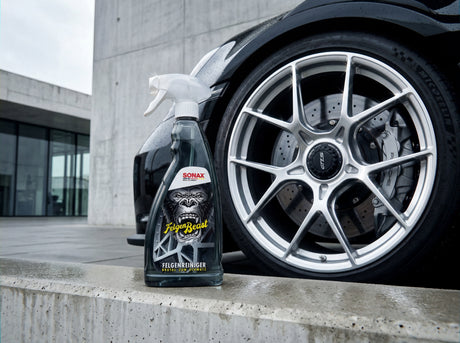
Brake dust on the rims is another limitation. Brake abrasion consists of iron particles that burn into the clear coat of the rim. Gsf has no iron-dissolving effect. Here, only a rim cleaner with reactive chemistry helps, for example, a Magic Wheel Cleaner with thioglycolate or a Rim Beast variant with acid.
Anyone who wants to use the foam as a substitute for a coating pre-product is also mistaken. Before applying a ceramic coating, the paint must be absolutely residue-free — wax residues, silicone oils, and sealant residues from previous washes must first be removed with an alkaline IPA cleaner. Gsf cleans gently, but it does not remove existing sealants. For coating preparation, this is the wrong class of tool.

Active Foam or Neutral Foam and When to Use Which
There are two classes of Snow Foams in the product range that are often confused. Active foams have a pH value between 11 and 13, while neutral foams like Gsf are around 7 to 8. The difference determines when you use which product.
Active foams are the right choice when a car is being restored after a long winter, when road salt and winter grime need to be removed, or when the surface must be completely grease-free before polishing. The high pH value quickly hydrolyzes organic residues, but at the expense of the sealant. Anyone who regularly washes a sealed car with active foam will measurably reduce the durability of their coating — an 18-month ceramic coating will then often only last six to nine months.
Gsf belongs in the weekly care routine for sealed vehicles. If you have applied a carnauba wax, a GYEON Q² Mohs coating, or a Koch-Chemie Protector-Wax layer, you want to preserve that layer. At pH 7.5, it remains untouched. The cleaning performance is entirely sufficient for typical weekly dirt.
The rule of thumb: If your car is newly sealed and you maintain it regularly, the neutral Gsf is the standard. If you fundamentally restore your car two or three times a year seasonally, an active foam like Koch-Chemie Magic Foam Premium is used once. Both have a place, but in the weekly workflow, the neutral variant is the right answer.
Who Gentle Snow Foam is the right choice for
Anyone looking to perform their first thorough exterior detailing after winter in May, who maintains their car weekly or bi-weekly, and wishes to preserve an intact sealant, will find Gentle Snow Foam to be exactly the right product. The one-liter bottle is sufficient for an entire detailing season from April to September with normal use.
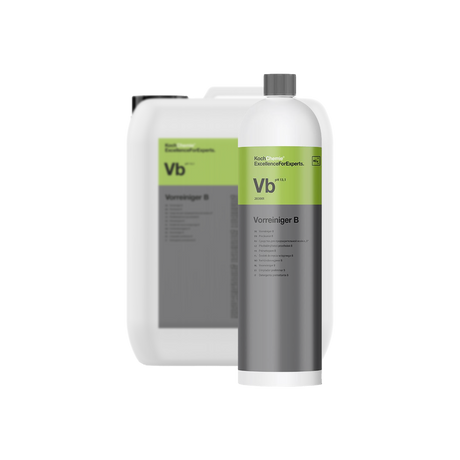
For detailing beginners, the one-liter variant is a sensible start. The investment is manageable, and if you only use the foam on your own car, it will last a long time. If you care for several vehicles in the family or, as an ambitious hobby detailer, regularly assist friends, the five-liter canister variant is more economical. A five-liter canister provides enough for approximately 250 pre-washes — covering several seasons.
The only important thing is that the hardware fits. The densest foam is created in a proper foam lance on a high-pressure cleaner, where you regulate the foam consistency by adjusting the water-to-air ratio. In a pump sprayer like the iK Foam Pro 2, the foam is softer, but entirely sufficient for weekly care and independent of a high-pressure cleaner. If you work in a courtyard or carport without high-pressure access, a pump sprayer is better. If you have access to a high-pressure cleaner, you will get more out of a foam lance.
Gsf also works on unsealed cars — it cleans just as well, but offers no additional benefit compared to a normal car shampoo. Its added value lies in protecting the sealant. So, anyone who has recently invested in a ceramic coating or works with wax will find a crucial advantage here.
When using Gsf for the first time, don't be discouraged if, after rinsing, the foam still shows noticeable yellowish pollen traces after the first May wash. This is normal after a month without contactless cleaning. The foam has done its job — the particles have softened and are now lying loosely, instead of adhering stickily. The subsequent hand wash with a wash mitt is then almost effortless because the pollen detaches on the first wipe without scratching the paintwork. From the second or third wash, the cleaning rhythm stabilizes, and the car looks visibly cleaner after each foam application.

Detailing1-Insight: In practice, we see that the difference in durability of sealants becomes visible primarily in the second half of the year. Those who wash with active foam throughout the summer will have a significantly weaker beading effect in September than someone who consistently used neutral foam. The only trick: honestly adhere to the mixing ratio; do not over-dose, because more foam does not mean more cleaning. Above a certain concentration, the surfactants do not work stronger, but only become more costly. 20 milliliters per liter is the optimum — anything above that is wasted concentrate.
No time for the whole post? Get it summarized: