



You lift iron fallout and tar in the dry-weather window, on cool paint
Three dry, warm days in a row have become a rare thing, and the first urge makes sense: get out in the sun and finally clear the iron fallout and tar off your paint. That's exactly where the thinking goes wrong. The very sun that pulls you outside is the reason your iron remover streaks and your tar wash smears before it has done any work at all.
If you want to decontaminate your paint, you need a dry window but a cool panel. Work in the shade, wash clean, and stick to the order iron, tar, clay, and you get the full punch out of every product, then finish with a sealant.

The dry summer window is your moment to decon
A fair-weather window of three dry days is the best moment for a thorough paint decontamination, because washing, removing and sealing run back to back with no rain breaking them up. For Nordhorn the forecast shows 18 degrees today under light cloud, then the numbers climb to 28 degrees with no rain slipping in between. In a northern German summer that line-up is the exception rather than the rule, and that's exactly why it pays to set such a window aside on purpose for the heavy jobs that need a dry surface.
Over the spring, every paint builds up a layer that a normal wash no longer takes off. Brake dust and rail dust embed as microscopic iron particles, tar and bitumen fling up off freshly resurfaced roads, and both dig into the clear coat mechanically and chemically. Run your fingernail — or better, a thin plastic bag — over a washed, dry bonnet, and if it feels rough instead of glass-smooth, that's exactly the contamination you're feeling: invisible from above, and still costing you gloss.
The reason to do it now, rather than at the height of summer or in the cold, wet autumn, is the mix of dryness and moderate warmth. You need the dryness for the solvent-based tar remover, which specifically works on a dry surface. You need the moderate warmth afterwards for the sealant, which bonds only grudgingly with the paint in cool, damp autumn weather and takes longer to cure. So the window gives you both conditions at once, which makes the order on the calendar just as important as the order on the car.
It's worth being honest about what you actually need: to decontaminate paint you don't want blazing midday light, you want dry hours. That means dry ground, hours you can plan around, and a surface you can pull into the shade when you have to. Miss that distinction — read every nice hour as an hour of sun on the metal — and you're working against your own products. That one distinction decides whether your products do their job, or whether active ingredient and money evaporate off a hot panel before anything even happens.
Why heat makes iron fallout and tar worse
On a hot panel in direct sun, almost every decon product flashes off before it can finish its chemical reaction, leaving streaks instead of clean surfaces. That goes for the acid-free iron remover just as much as the solvent-based tar remover, and it's by far the most common reason a summer decon fails and then gets written off as a faulty product, when the temperature was to blame.
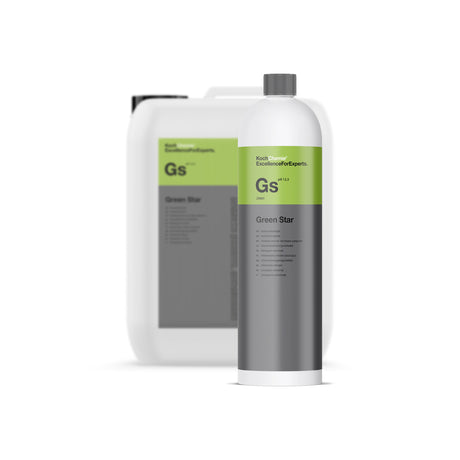
The Koch-Chemie Reactive Rust Remover is an acid-free, pH-neutral iron remover that reacts with the iron(III) oxides through its active ingredient ammonium mercaptoacetate, the ammonium salt of thioglycolic acid. That reaction shows up as a violet colour change and needs dwell time. Let the product flash off early on sun-baked metal and the reaction breaks off, the colour change never comes, and the iron particle stays put in the paint.
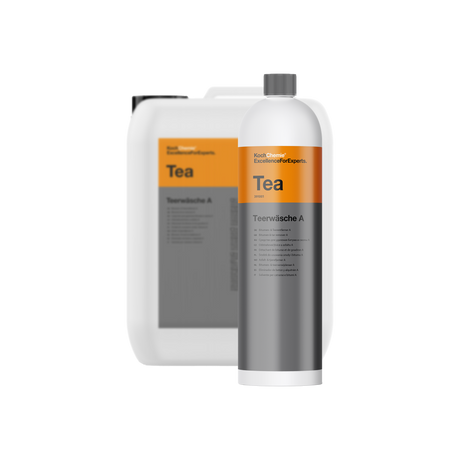
With the Koch-Chemie Teerwäsche A it's the volatility of the solvent. The cleaner works off a base of C10 to C13 hydrocarbons with under two percent aromatics and loosens tar in thirty seconds to three minutes. On a hot panel the solvent evaporates faster than it can break open the molecule chains of the bitumen, and the half-dissolved tar smears into a brown film instead of rinsing away clean.
On top of that comes the plain stress on the material: reactive residues that dry onto a scorching surface are harder to remove and sit on the clear coat longer than they need to. The rule of thumb: a panel you can still rest your flat hand on comfortably. Once it turns uncomfortably hot, the car belongs in the shade before a single drop goes on.

Wash first, then iron, then tar, then clay
Decontaminating paint works in the order wash, chemical iron removal, tar removal, and finally the mechanical clay bar, because each step takes work off the surface that the next one would otherwise have to do with more friction. Keeping to that order protects the paint more than any single product does.
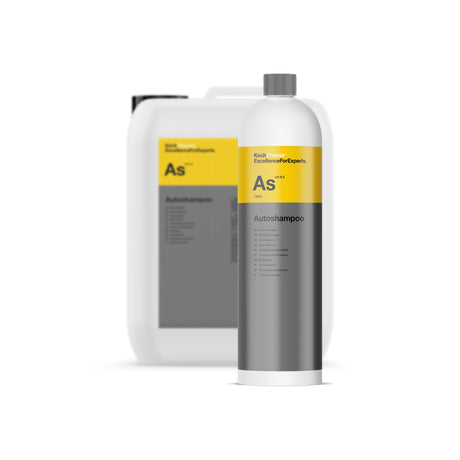
It starts with a low-contact wash using Koch-Chemie Autoshampoo, a mildly alkaline shampoo at pH 9 that gives you around eight car washes from one litre while going easy on any wax and sealant already there. A clean base is non-negotiable, because every loose grit of dirt you don't wash off before claying turns into an abrasive particle later. Wash in the early hours, while the metal is still cool.
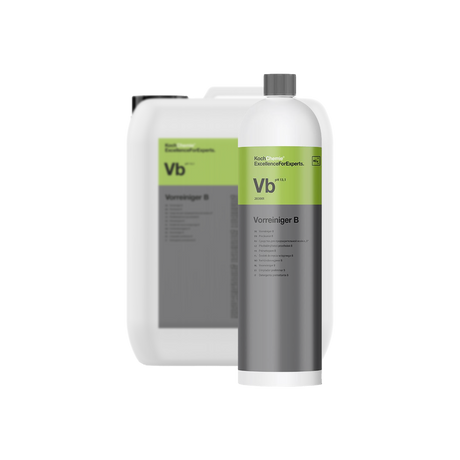
Then the Reactive Rust Remover goes onto the dried, cool surface. You spray it on evenly, wait for the violet colour change to show the dissolved iron particles, and then rinse thoroughly before the product can dry on. Only once the iron is gone does the tar remover go on neat, over the dry, tar-loaded spots on the sills and the lower door area, with a short dwell of thirty seconds to three minutes and a high-pressure rinse afterwards. Splitting the chemical iron step from the tar step keeps the two very different working principles from tripping each other up.
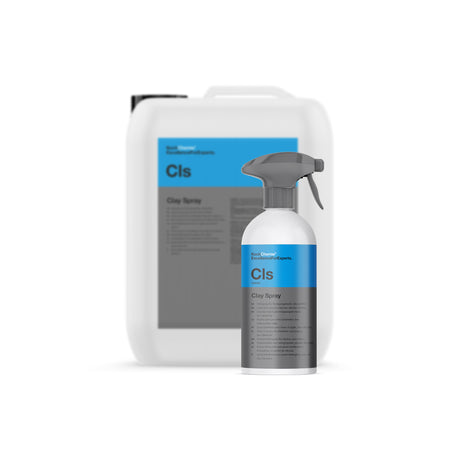
To finish, the Koch-Chemie Reinigungsknete Mild with plenty of Clay Spray lubricant, which keeps scratching to a minimum and leaves no greasy film. The mild blue clay bar picks up the last embedded traces of tree sap, industrial dust and overspray that the chemistry didn't dissolve. After that the paint feels glass-smooth, and that's exactly the base for everything that follows. If you want to read the whole process step by step, you'll find it in our guide to the proper decontamination of iron fallout, tar and tree sap.
Which products you need for the summer decon
A full summer decon calls for four jobs: a wax-safe shampoo for the pre-wash, an iron remover for the iron, a tar remover for the bitumen, and a clay bar with lubricant for the mechanical fine work. Each one tackles a different kind of contamination, and none replaces another. The mistake of trying to solve it all in one go with a single do-it-all costs you more time in the end, because the wrong product on the wrong contaminant just smears the surface instead of truly clearing it.
The Koch-Chemie Autoshampoo handles the base wash, phosphate- and NTA-free, and is only safe on fresh ceramic coatings at a 1:15 dilution. The Reactive Rust Remover is the iron specialist and works on paint, glass and wheels, but it's expressly not meant for tar, oil contamination or baked-on brake dust from race brake setups. That very limit is what makes the next step necessary.
The Teerwäsche A, with Daimler approval, closes the gap on tar, bitumen and oil and grease residues. It's free of halogenated hydrocarbons, but it must not go on rubber, EPDM seals, soft plastic trim or freshly sealed paint. That's why it sits before the sealant in the sequence, never after. On the surface itself, keep it to solvent-resistant, painted metal.
The mechanical finish comes from Reinigungsknete and Clay Spray as an inseparable pair, because the clay bar only works safely with plenty of lubricant. If you've got heavily crusted overspray or coarse industrial dust, reach for the abrasive red version instead of the mild blue one — but expect a light polish afterwards, since the coarser clay can leave fine holograms. For the everyday road car, the mild blue almost always does the job. You'll find everything you need bundled in the Iron Remover and Paint Prep collections.

These are the mistakes summer heat makes really expensive
The priciest summer mistake is dragging the clay bar over dry or too-hot paint, because without an unbroken glide film every trapped particle acts as grit and draws fine scratches. On a hot panel the lubricant evaporates faster too, the clay starts to grab instead of glide, and a prep step turns into a fresh job you then have to polish out. Better to work small areas, lay the Clay Spray on generously and top it up, and fold the clay regularly so the picked-up particles don't land back on the paint.
Just as common is impatience with the iron remover. Spray it in the sun and wipe it straight off, and you give the thioglycolic acid no time for the colour change and throw away half the effect. The second classic mistake is the wrong order: tar remover on still-dirty paint does dissolve the bitumen, but the loose dirt underneath gets dragged across the surface as you rinse.
An easily overlooked point is the edges. The tar remover is a solvent and attacks rubber seals, soft plastic trim and fresh sealant. Spray liberally over the sill and catch the trim strips and seals along the way, and you trade clean tar for bleached-out rubbers. Apply on target and rinse quickly — that's the whole art here.
And finally, sealing over contaminated paint. Skip the decon and seal straight away, and you lock iron fallout and tar under the protective layer. The protection then lasts less time, looks blotchy, and the trapped iron particles keep working away under the sealant. Order beats haste, every time.
After the decon, seal straight away while it's dry
The real point of putting the decon in a dry window is the chance to seal right afterwards, while the paint is clean, glass-smooth and cool. A freshly decontaminated surface is more ready to take a sealant than at any other time, and that state holds for only a few hours before fresh dust settles.
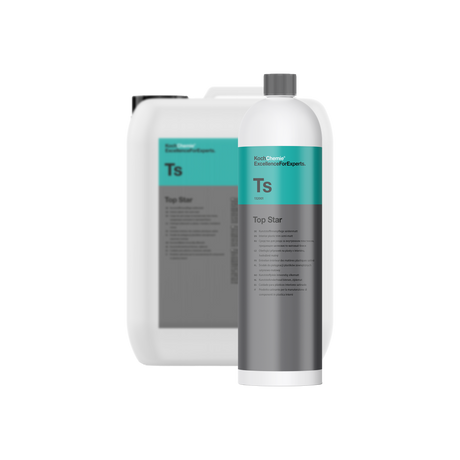
A nano sealant like the Koch-Chemie 1K-Nano paint sealant builds a protective film on the clean surface that lets insects, bird droppings and road grime bead and wipe off more easily from then on, and with regular care it can last up to three years. Lay it on the cool, dry metal in the shade, not in full sun, or the product runs streaky instead of bonding cleanly. How a spray sealant holds up against pollen and sap at the height of summer we cover separately in our piece on the spray sealant in high summer.
Prevention after that mostly means slowing the build-up of contamination back down. Wash consistently with the mildly alkaline, wax-safe shampoo after the decon, and don't stress the fresh sealant over the paint edge with harsh acidic wheel cleaners, and you push the next big decontamination back by many months. On a sealed surface, iron and tar dig in less and come off far more easily next time, often in the normal wash already. That turns the rare, heavy deep clean into many small, gentle washes — and that rhythm is exactly what keeps the paint slick through the season.

Detailing1-Insight: Day-to-day at our showroom in Nordhorn, we always put the car on the shady side of the warehouse for the decon and work our way along panel by panel, rather than spraying the whole car at once. On a white test car last summer we made the mistake of laying the Reactive Rust Remover down over a whole side at 26 degrees in the sun. Halfway along, the first door had already dried on, the violet colour change came out blotchy, and we had to do that section twice. Since then the rule stands: one door, one bonnet, one wing, in the shade, and only then the next part.
No time for the whole post? Get it summarized: